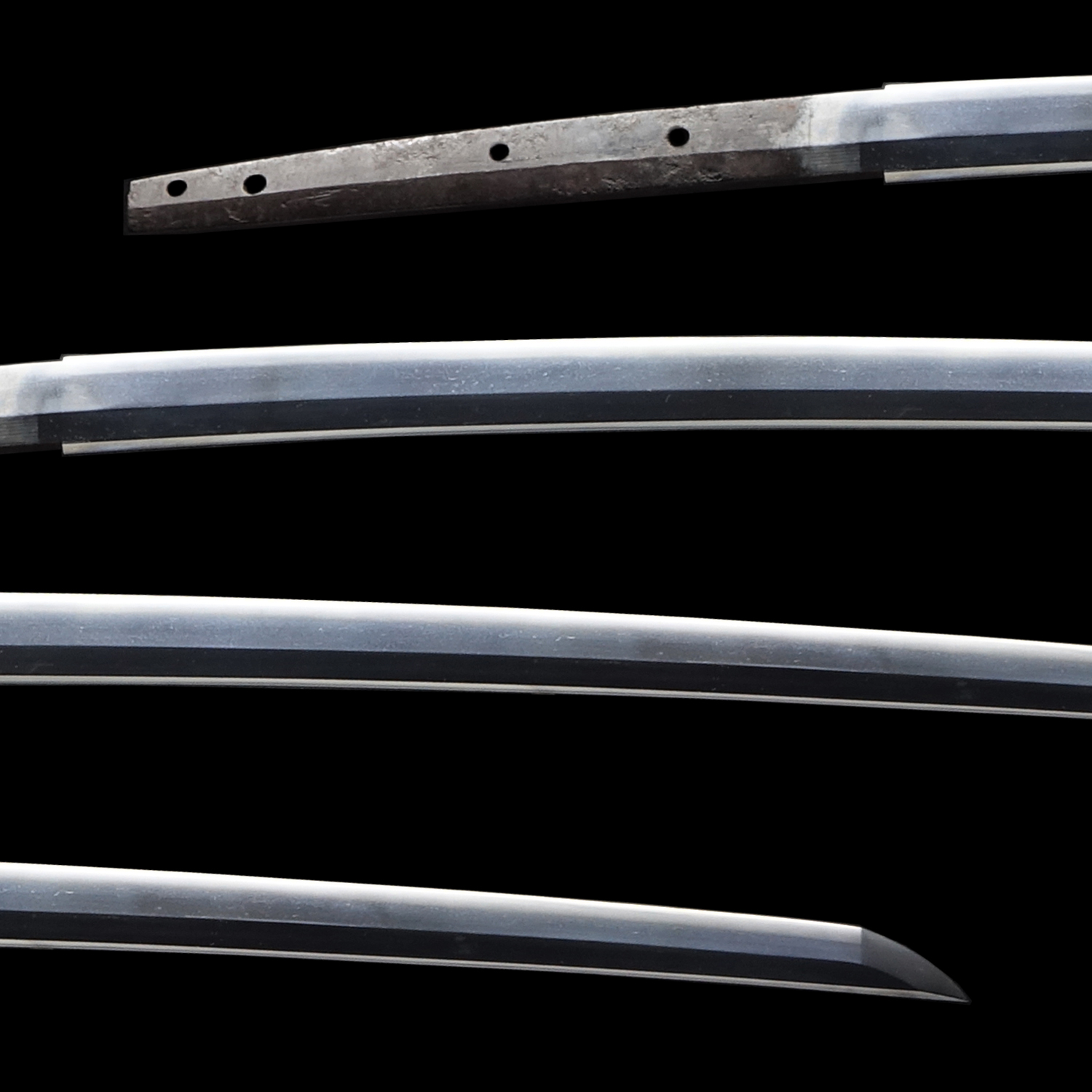
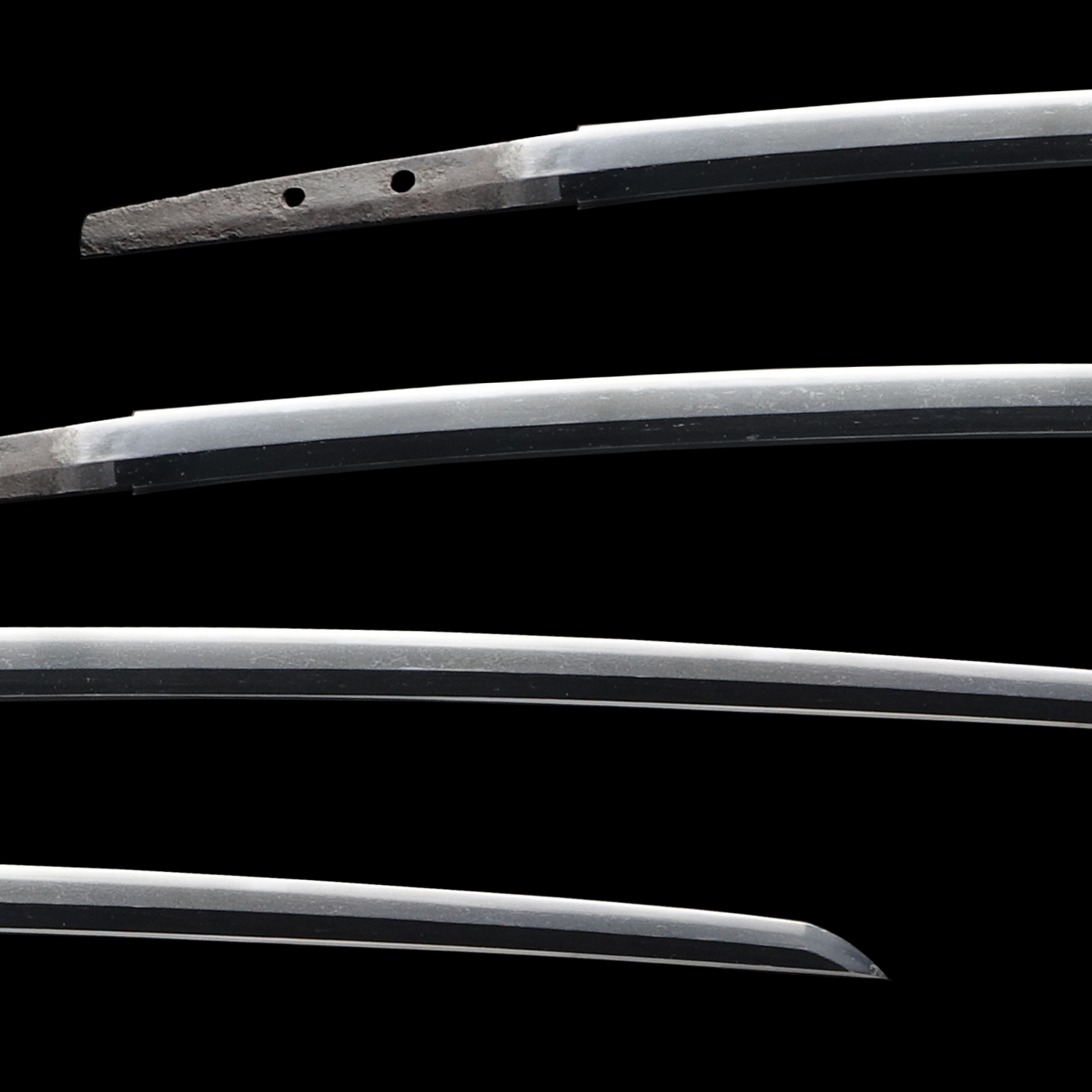
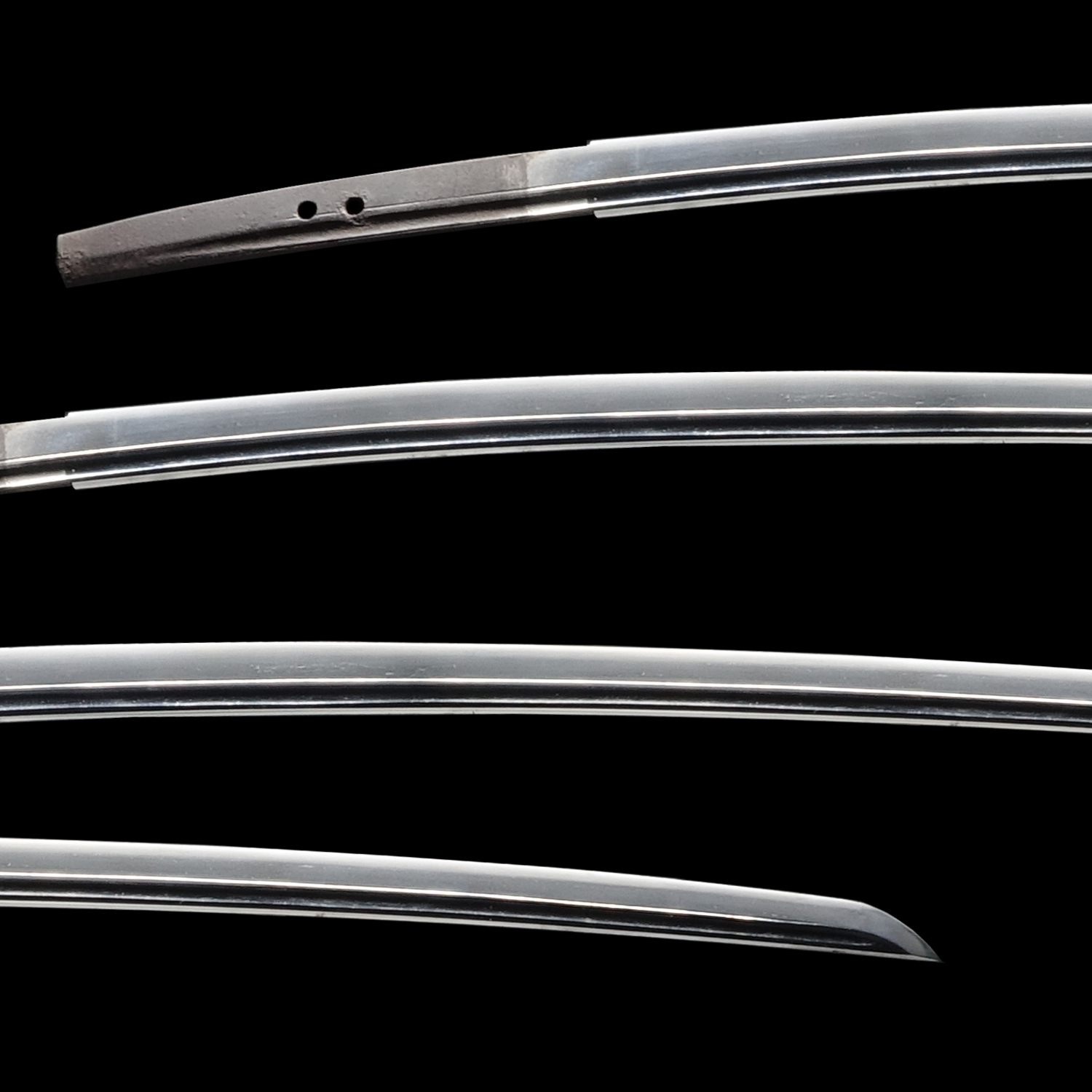
Given that you have read our first article (If you haven’t, see here ), now you know different types of Japanese swords. Today, we would like to delve into it a little more and write about the differences by the age of each Japanese sword.
INDEX
Chapter 1: The History of the Curvature of Japanese swords
Chapter 2: The Ages of Japanese Swords
・JO-KO-TO(上古刀)
・KO-TO (古刀)
・SHIN-TO(新刀)
・SHIN-SHIN-TO(新新刀)
・GENDAI-TO(現代刀)
Chapter 1: The History of the curvature of Japanese swords
Dating back to the earliest years of the Samurai times (The HEIAN-Period; 794-1185 A.D.), There would be a lot of non-curved Japanese swords. That trend changed as the regime of ancient Samurai families had taken over the imperial government of Japan in the 10th century. There was the whole transition from the straight sword(CHOKU-TO; 直刀) to the curved sword(WAN-TO(湾刀; ).
The Japanese sword have seen rapid, drastic changes after the mid-HEIAN-Period due to the transition of war strategies. The swordsmiths modified the swords in various ways following the clan’s war reports so that Samurai could use their swords more efficiently.
Chapter 2: The Ages of Swords
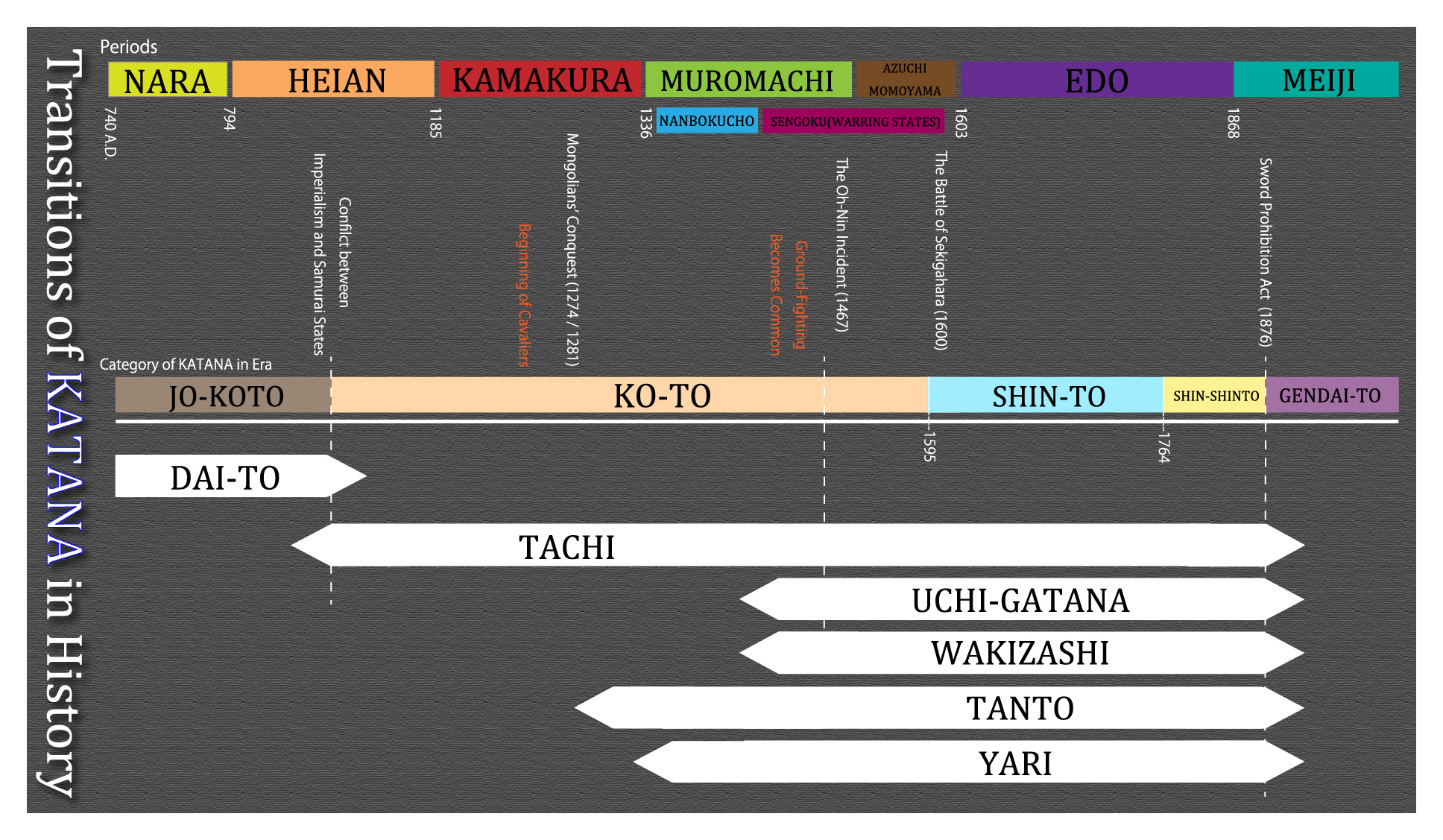
The chart below shows the ages of Japanese swords in chronological order. In Chapter 2, we are going to explain the characteristics of Japanese swords in each era.
・JO-KO-TO(上古刀)
JO-KO-TO is mostly straight since they were copies of the swords from the continent. Usually, they were only discovered in the excavation sites from ancient times, or heritage sites of the ancient empire of Japan (5-8C).
・KO-TO (古刀)
The swords made between the Late Heian Period towards the end of the Warring States (930-1595 A.D.) are called KOTO (古刀: Old-Sword) in Japanese. Those swords were likely to be used in real lives of Samurai, so their designs had to fit the way they used the sword. It is hard to generalize Koto but they typically have a more aesthetically masculine look than those of the other eras. The blacksmithing technique wasn’t fully developed yet in this era, so the KO-TO blades contain gold, silver, and other metals, making the surface pattern of Koto intricate and beautiful.
I: From Late-Heian to Early-Kamakura period(10 C-)
The swords from this era were the first to have the shape of Tachi. The curvature starts from the handle to the middle and becomes steeper towards the edge. We call this design KOSHI-ZORI(腰反り; Waist-Curve).
II: Mid-Kamakura period(Appx. 13 C)
From the mid-Kamakura Period, TACHI was made to look even more magnificent. The upper half of the blade was forged thicker, which means the overall blades were a little flatter than the previous ones.
III: Late-Kamakura period(Appx. 1274-1333 A.D.)
The blades have become longer and thinner during this era. They also resemble the Early-Kamakura style, but such sharpness at the peak cannot be seen in the Early-Kamakura swords.
VI: Nanbokucho-period (1336-1392 A.D.)
In this era, Tachi have become the largest in history. Swordsmiths reduced layers of steel in the blade to keep it light and easy to wield the sword in hand. They also tend to have HI(樋; Gutter) on the blade since it would otherwise be too heavy.
V: Early-Muromachi period(1367-1467 A.D.)
The swords from this period mostly resembled the Kamakura-style swords. At the same time, there is also a curvature from the middle towards the peak.
IV:Middle Muromachi Period-Late Muromachi period(1467-1573 A.D.)
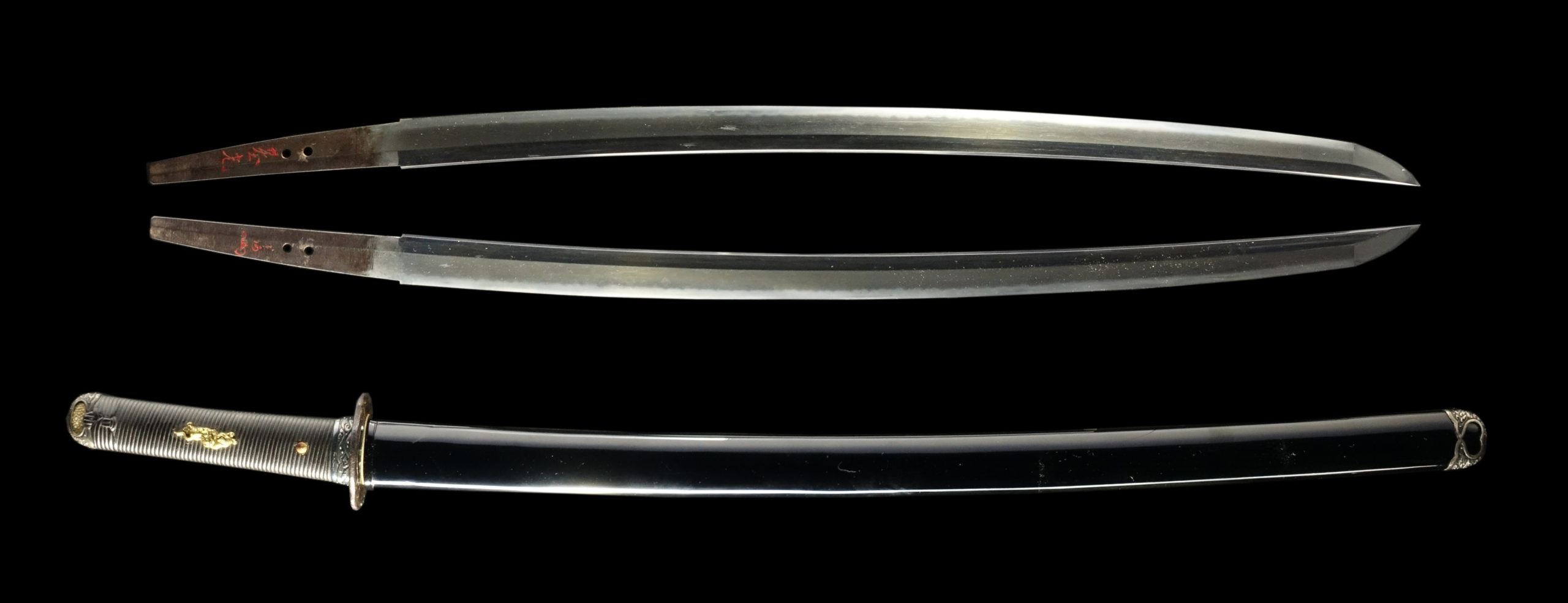
As of this era, soldiers began to fight on the ground, so UCHI-GATANA(Katana) was made for the first time. They are shorter, and typically have the strong curvature from the middle to the edge.
Since it was also in the middle of the Warring States period (Sengoku Jidai), some swords were relatively low-quality to cater to the clan’s high demands for weapons to provide foot soldiers with. The high-quality swords forged during the Warring States are called CHUMON-UCHI (注文打; custom-made). There were also popular sword forging schools which often had orders from high-class Samurai, such as Bizen Osafune school.
Ⅶ: Azuchi-Momoyama period(1573-1594 A.D.)
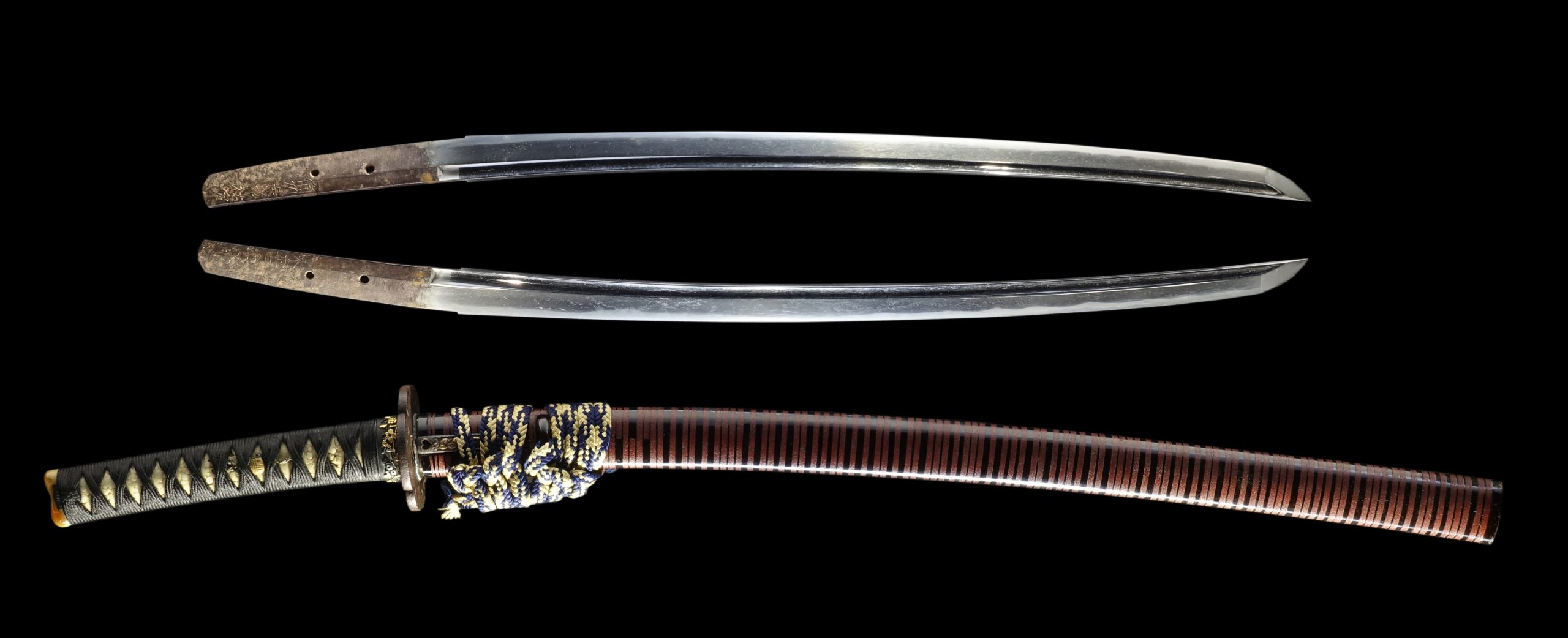
Amidst the Warring States (c. 16C), swordsmiths had gathered around the castle towns of great Samurai warlords such as Edo city (Today’s Tokyo). Transport links between the provinces became way faster in this era, and there were also swords made of steel brought from western countries.
The swords from this era are very similar to OH-SURIAGE(大摺上げ; Heavily-Sharpened), which had formerly been Tachi but were adjusted to the size of Uchi-Gatana. The blade is usually thick and tends to have more layers of steel.

・SHIN-TO(新刀)
IIX: Late Azuchi-Momoyama -Mid of Edo Period (1596 A.D.-1763 A.D.)
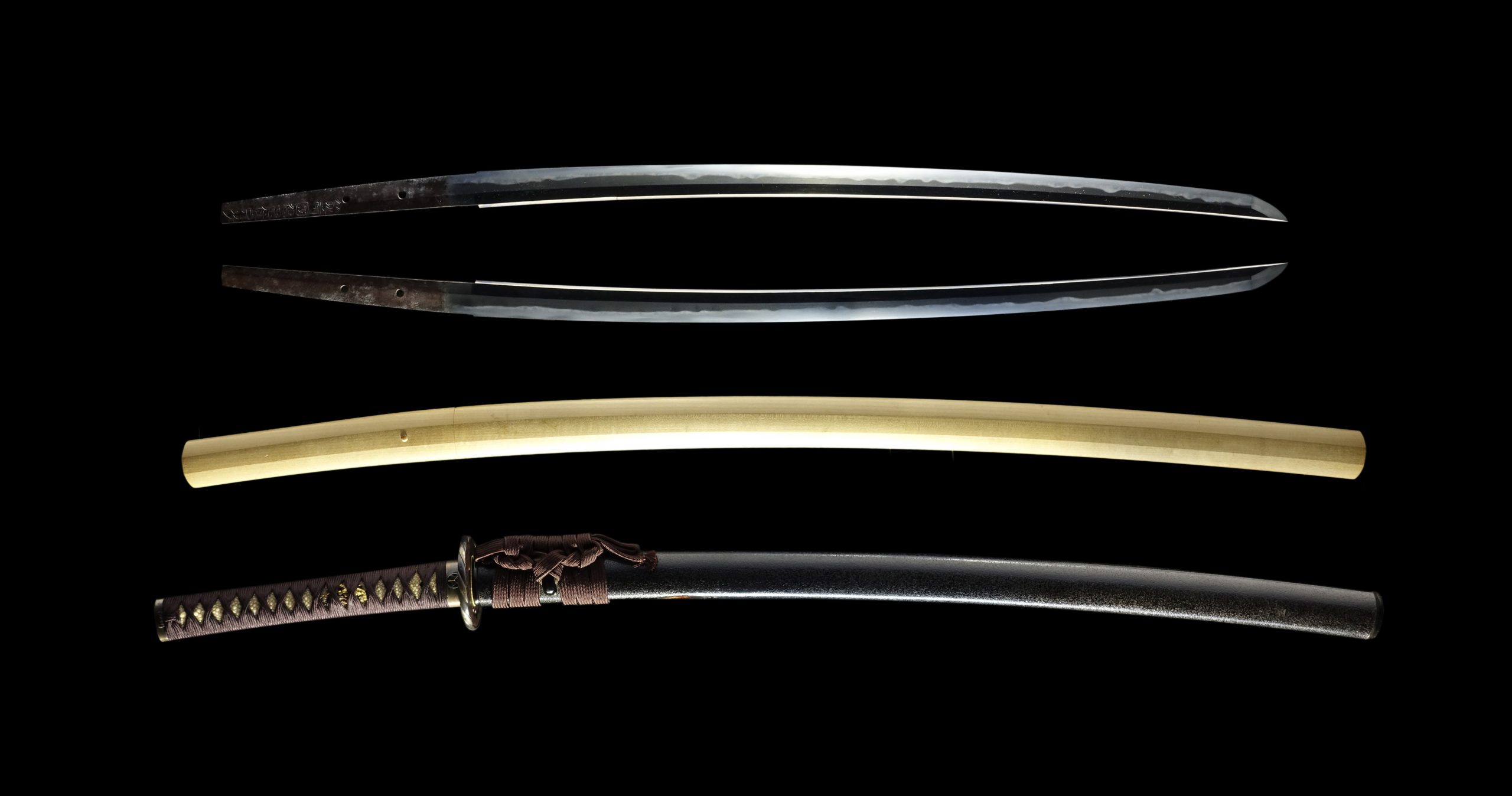
As opposed to KO-TO, SHIN-TO refers to the swords forged from 1596(Keisho-era) until around 1763. It is said that carbon steel (Tamahagane) used during this time was pure because of the development of metal-tempering. Also, the peaceful state of Edo period allowed many swordsmiths to pursue their technical improvement. Thus, it became easier for the swordsmiths to make a custom-made blade just as requested by Samurai than the KOTO era.
SHIN-TO is generally heavier and thicker, and less curved than KO-TO. And it tended to have gorgeous, intricate designs in the EDO Period (1603-1868 A.D.). In the early Edo period, swords had less curvature and were thinner towards the edge. We mainly refer to those as KANBUN-SHINTO (寛文新刀; Sword of the KANBUN era) given that most of the famous swords that represent the early Edo style were made during the KANBUN Era (1661-1673 A.D.)
IX: Mid-Edo period (Since the GENROKU Era; 1688-1704 A.D. and onward
The swords from this era restored the graceful curvature on the blade, as the government had experienced the most peaceful state in history. There were also engraved artworks on some of those.
・SHIN-SHIN-TO(新新刀) (1764-1876 A.D.)
From the 1760s onwards the end of the Samurai times, there was a revival movement of KO-TO styled swords. We refer to those made at that time as SHIN-SHIN-TO. Thus, SHIN-SHIN-TO usually resembles KO-TO of the old era, which is seen in its magnificent look. They were also made longer and had less curvature than the ones of the previous eras.
・GENDAI-TO(現代刀)
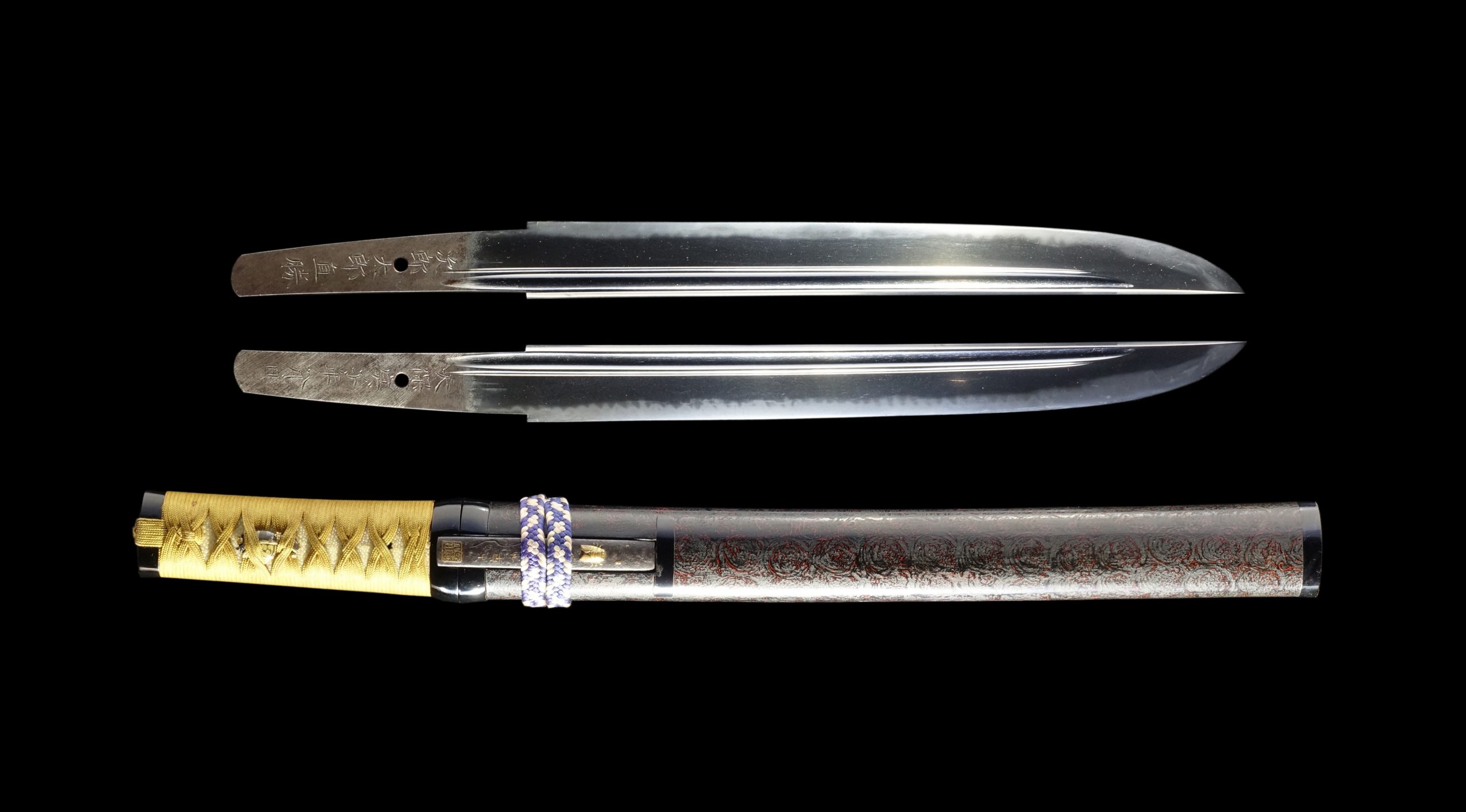
Edict of the 9th of the Meiji Era (1878 A.D.), following the decline of the Samurai regime, the Sword Prohibition Bill took effect in Japan. Thus, many Japanese swordsmiths lost their jobs, but the craftsmanship was preserved by the government, with the two well-known swordsmiths GASSAN and KANENORI being selected as the national sword artists. When it comes to the features of Gendai-To, You can seek references to the swords from different eras, most of which were inspired by the Kamakura-style.
There are around 150-200 swordsmiths in Japan today. Those who practice Iaido(居合道) use those GENDAI-TO, and there are international Japanese sword collectors who order their new custom-made blades. The contemporary Japanese sword makers are researching old ways to forge swords and try to recreate ancient style swords. They are the ones who keep the tradition of Japanese history alive.

——————————————————————————————————-
Did you enjoy this article? Which one do you like better? KO-TO? SHIN-TO? All of these are remains of Samurai history and worth preserving for centuries. We hope this article helps you understand more about the features of swords from each period.
We also deal with Japanese swords from different eras. You may be able to notice what is unique about our collection of Japanese swords. Hopefully, some of you are now interested in owning one of them. You can just click the embedded links on the pictures, or visit HERE to have a look at all collections. We are looking forward to serving you out there anytime.
Samurai Museum
Email: order@samuraimuseum.jp
TEL:+81 3 6457 6411
-
$13,227.68
DELIVERY TIME : Approx. 1-1.5 months
*There might be delay in shipment depending on countries
SHIPPING TO :
USA, Canada, Mexico, Germany, Belgium, France, Finland, Hong Kong, Australia
*Please contact us prior to purchase if your country isn’t listed.
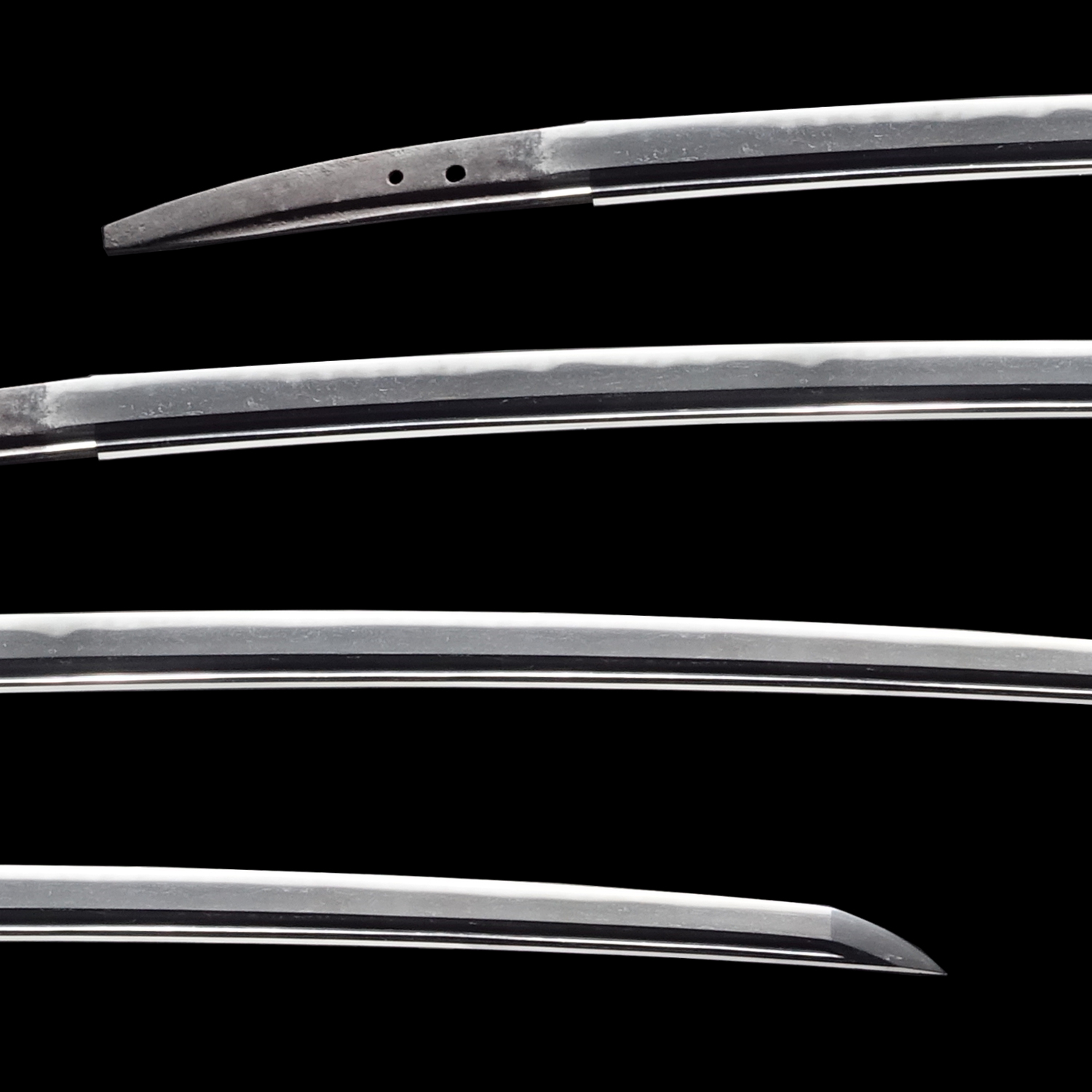
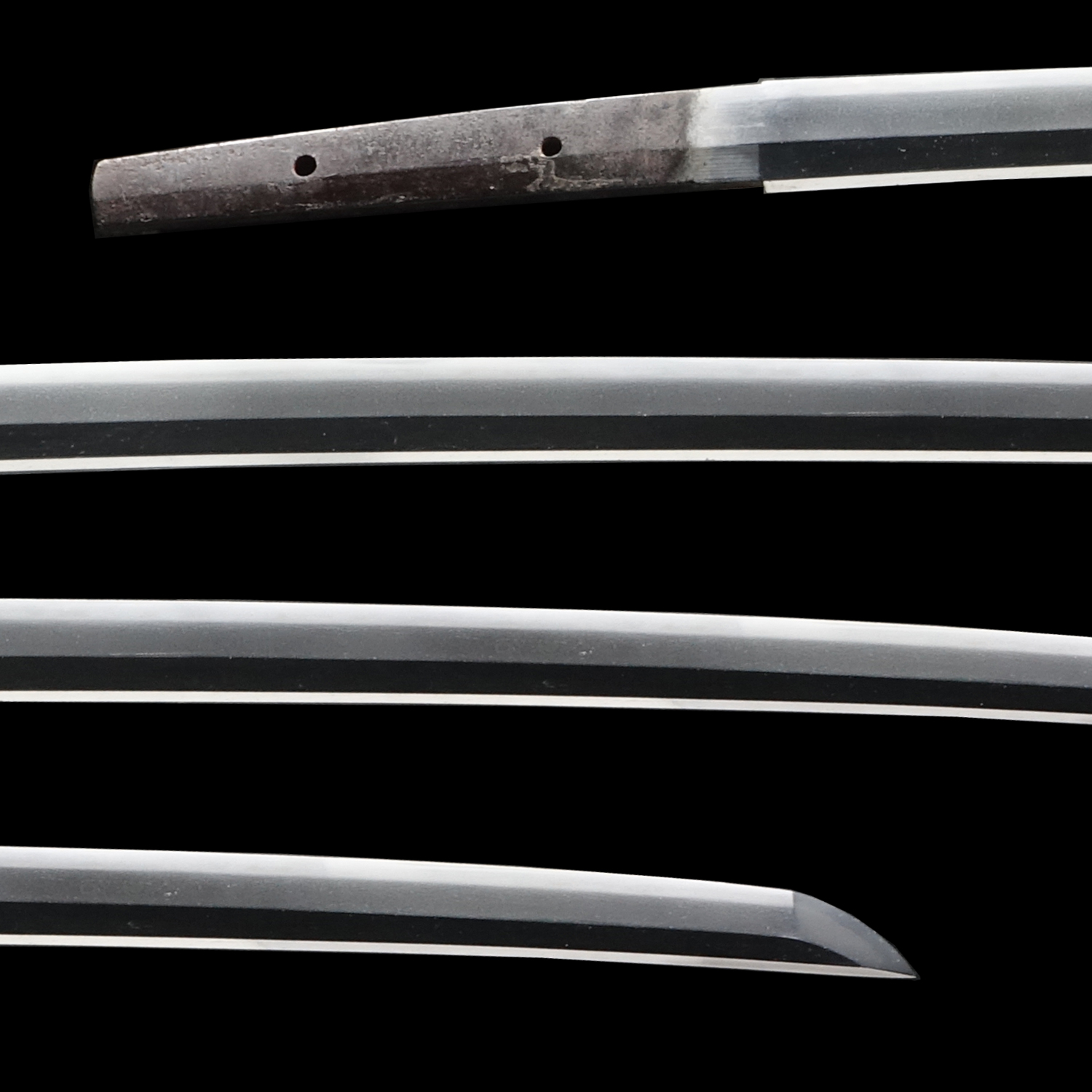
INCLUDED : NBTHK Hozon Certificate for Katana/Wakizashi, Koshirae Mounting×2, Shirasaya Case×2, Traditional Sword Carrying Case×2, Sword Maintenance Kit, Full Exportation Support
| Category |
Katana (KOTO)&Wakizashi (KOTO) |
| Age |
Katana: Mid-Late Muromachi period
(Late 15th -early 16th century)
Wakizashi: Late Muromachi Period
(Early 16th century) |
| Swordsmith |
Attributed to Shigaseki (志賀関: Unsigned)
Attributed to Daido (大道: Unsigned) |
| Certificate |
NBTHK Hozon Certificates for the blades |
| Location |
Owari province (Today’s Aichi prefecture)
Mino province (Today’s Gifu prefecture) |
| Blade Size |
Cutting Edge Length: 65.8 cm (25.9 inches)
Curvature: 1.8 cm (0.70 inches)
Cutting Edge Length: 37.6 cm (14.8 inches)
Curvature: 1.1 cm (0.43 inches) |
More photos& videos available on request. Please feel free to contact us.
If you like to enlarge the photos, please click  on the right corner of the photo.
-
$16,377.13
DELIVERY TIME : Approx. 1-1.5 months
*We ship from Tokyo, Japan. There might be delay in shipment depending on countries.
SHIPPING TO :
USA, Canada, Mexico, Germany, Belgium, France, Finland, UK, Hong Kong, Australia
*Please contact us prior to purchase if your country isn’t listed.
INCLUDED : NBTHK Tokubetsu Hozon Certificate for the Katana, NBTHK Tokubetsu Kicho Certificate for the Koshirae, Shirasaya Case, Koshirae Mounting (Decorative Sword Mountings), Traditional Sword Carrying Case, Sword Maintenance Kit, Full Exportation Support
| Category |
Katana (SHINTO) |
| Age |
Early Edo Period (1641-1688) |
| Swordsmith |
Hizen Koku Jyu Omi no Daijyo Fujiwara Tadahiro (肥前国住近江大掾藤原忠広) |
| Certificate |
NBTHK Tokubetsu Hozon Certificate for the blade & Tokubetsu Kicho for the Koshirae |
| Location |
Hizen province (Today’s Saga prefecture) |
| Blade Size |
Cutting Edge Length: 67.8 cm (26.6 inches)
Curvature: 1.8 cm (0.70 inches) |
More photos& videos available on request. Please feel free to contact us.
If you like to enlarge the photos, please click on the right corner of the photo.
-
$53,540.61
DELIVERY TIME: Approx. 1-1.5 months
*We ship from Tokyo, Japan. There might be delay in shipment depending on countries.
SHIPPING TO:
USA, Canada, Mexico, Germany , Belgium, France, Finland, UK, Hong Kong, Australia
*Please contact us prior to purchase if your country isn’t listed.
INCLUDED: NBTHK JUYO TOKEN Certificate, Shirasaya Case, Koshirae Case, Traditional Sword Carrying Case, Sword Maintenance Kit, Full Exportation Support
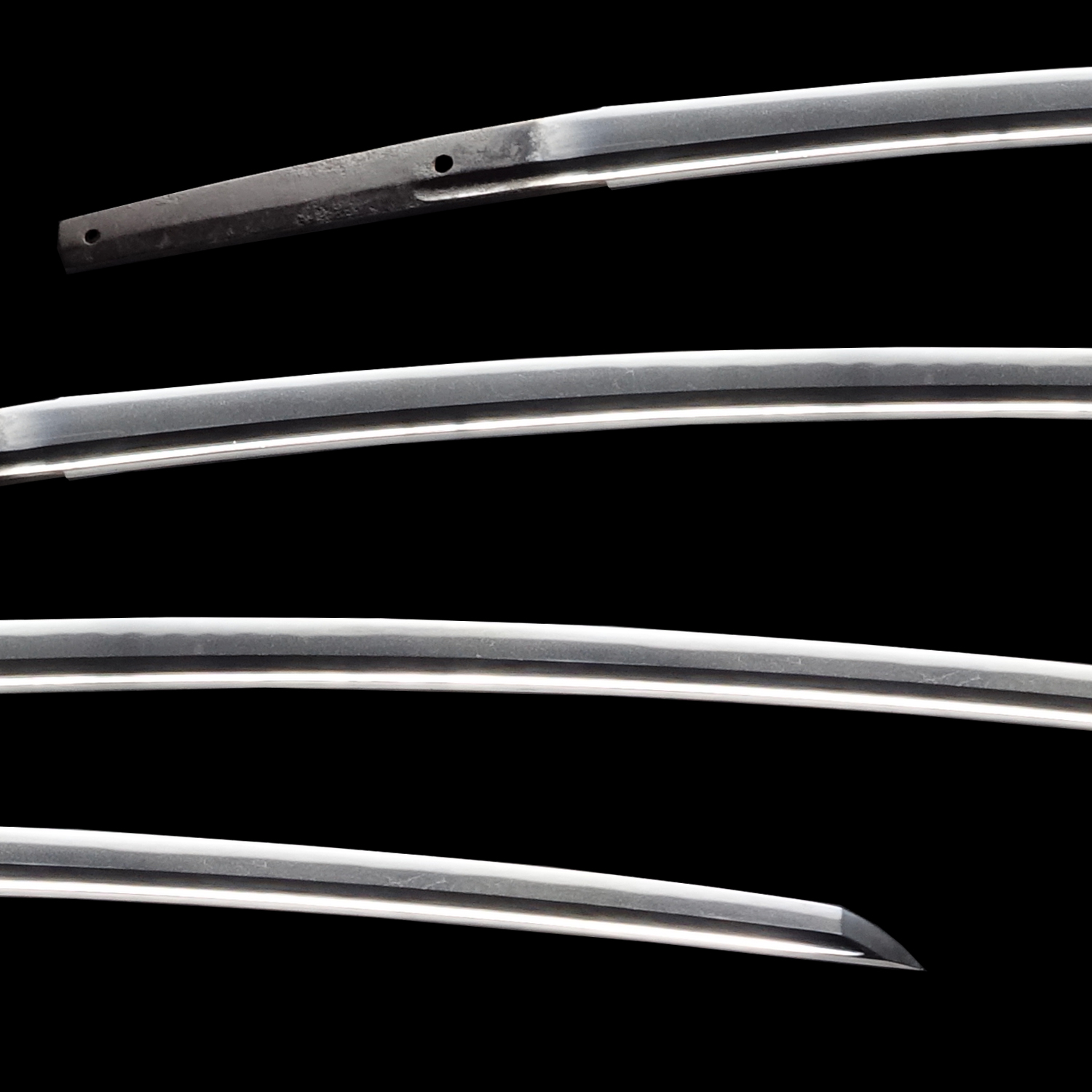
| Category |
Katana (KOTO) |
| Age |
The beginning of the Murmachi period (late 14th-early 15th century) |
| Swordsmith |
Attributed to Omiya Morikage (大宮盛景: Unsigned) |
| Certificate |
NBTHK JUYO TOKEN Certificate |
| Location |
Bizen province (Today’s Okayama prefecture) |
| Blade Size |
Cutting Edge Length: 73.2 cm (28.8 inches)
Curvature: 2.7 cm (1.06 inches) |
More photos& videos available on request. Please feel free to contact us.
If you like to enlarge the photos, please click on the right corner of the photo.
-
$56,060.17
DELIVERY TIME: Approx. 1-1.5 months
*We ship from Tokyo, Japan. There might be delay in shipment depending on countries.
SHIPPING TO:
USA, Canada, Mexico, Germany , Belgium, France, Finland, UK, Hong Kong, Australia
*Please contact us prior to purchase if your country isn’t listed.
INCLUDED: NBTHK JUYO TOKEN Certificate, Shirasaya Case, Koshirae Case, Traditional Sword Carrying Case, Sword Maintenance Kit, Full Exportation Support
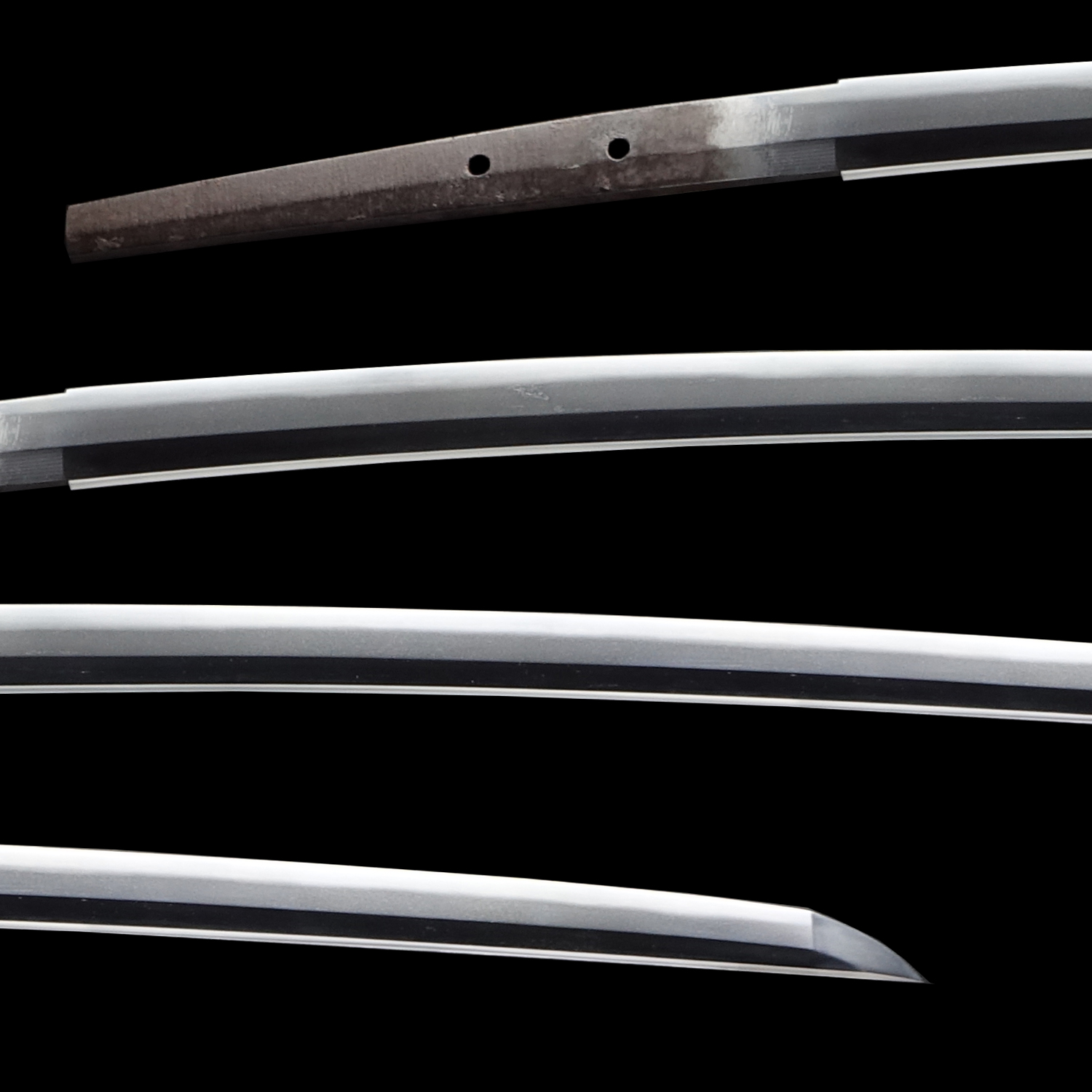
| Category |
Katana (KOTO) |
| Age |
Late Kamakura period (late 13th century) |
| Swordsmith |
Attributed to Hatakeda Sanemori(畠田真守: Unsigned) |
| Certificate |
NBTHK JUYO TOKEN Certificate |
| Location |
Bizen province (Today’s Okayama prefecture) |
| Blade Size |
Cutting Edge Length: 70.4 cm (27.7 inches)
Curvature: 1.4 cm (0.55 inches) |
More photos& videos available on request. Please feel free to contact us.
If you like to enlarge the photos, please click on the right corner of the photo.
-
$4,535.20
DELIVERY TIME : Approx. 1-1.5 months
*We ship from Tokyo, Japan. There might be delay in shipment depending on countries.
SHIPPING TO :
USA, Canada, Mexico, Germany, Belgium, France, Finland, Hong Kong, Australia
*Please contact us prior to purchase if your country isn’t listed.
INCLUDED : NBTHK Hozon Certificate, Shirasaya Case, Koshirae Mounting, Traditional Sword Carrying Case, Sword Maintenance Kit, Full Exportation Support
| Category |
Katana (KOTO:新刀) |
| Age |
Tensho era (1573-1592: Azuchi Momoyama period) |
| Swordsmith |
Attributed to Sainoo Morihiro (道祖尾守広:Unsigned) |
| Certificate |
NBTHK Hozon Certificate |
| Location |
Houki province (Today’s Tottori prefecture) |
| Blade Size |
Cutting Edge Length: 64.7 cm ( 25.4 inches)
Curvature: 1.0 cm (0.39 inches) |
More photos& videos available on request. Please feel free to contact us.
-
$3,653.36
DELIVERY TIME : Approx. 1-1.5 months
*We ship from Tokyo, Japan. There might be delay in shipment depending on countries.
SHIPPING TO :
USA, Canada, Mexico, Germany , Belgium, France, Finland, UK, Hong Kong, Australia
*Please contact us prior to purchase if your country isn’t listed.
INCLUDED : NBTHK Hozon Certificate, Shirasaya Case, Koshirae Mounting, Traditional Sword Carrying Case, Sword Maintenance Kit, Full Exportation Support
| Category |
Katana (KOTO :古刀) |
| Age |
Late Muromachi Period (late 15th-mid 16th century) |
| Swordsmith |
Attributed to Kaifu (海部: Unsigned) |
| Certificate |
NBTHK Hozon Certificate |
| Location |
Awa province (Today’s Tokushima prefecture) |
| Blade Size |
Cutting Edge Length: 69.8 cm (27.4 inches)
Curvature: 1.5 cm (0.59 inches) |
More photos& videos available on request. Please feel free to contact us.
If you like to enlarge the photos, please click on the upper right corner of the photo.
-
$8,188.56
DELIVERY TIME: Approx. 1-1.5 months
*We ship from Tokyo, Japan. There might be delay in shipment depending on countries.
SHIPPING TO:
USA, Canada, Mexico, Germany, Belgium, France, Finland, UK, Hong Kong, Australia
*Please contact us prior to purchase if your country isn’t listed.
INCLUDED: NBTHK Hozon Certificate for the blade, Tokubetsu Kicho Kodogu Certificate for the Koshirae, Koshirae Case (Decorative Sword Mounting), Shirasaya Case, Traditional Sword Carrying Bag, Sword Maintenance Kit, Full Exportation Support
| Category |
Katana (SHINTO: 新刀) |
| Age |
Shintō period (新刀期: 1596–1780) |
| Swordsmith |
Attributed to Shimada (島田: Unsigned) |
| Certificate |
NBTHK Hozon Certificate |
| Location |
Suruga province (Shizuoka prefecture) |
| Blade Size |
Cutting Edge Length: 68.0 cm ( 26.7 inches)
Curvature: 1.2 cm ( 0.47 inches) |
More photos& videos available on request. Please feel free to contact us.
If you like to enlarge the photos, please click on the right corner of the photo.
-
$4,724.17
DELIVERY TIME : Approx. 1-1.5 months
*We ship from Tokyo, Japan. There might be delay in shipment depending on countries.
SHIPPING TO :
USA, Canada, Mexico, Germany, Belgium, France, Finland, Hong Kong, Australia
*Please contact us prior to purchase if your country isn’t listed.
INCLUDED : NBTHK Hozon Certificate, Shirasaya Case, Koshirae Mounting, Traditional Sword Carrying Case, Sword Maintenance Kit, Full Exportation Support
| Category |
Katana (KOTO:古刀) |
| Age |
Late Muromachi period. (1492-1569) |
| Swordsmith |
Attributed to Taira Takada (平高田: Unsigned) |
| Certificate |
NBTHK Hozon Certificate |
| Location |
Bungo province (Today’s Oita prefecture) |
| Blade Size |
Cutting Edge Length: 65.2 cm ( 25.6 inches)
Curvature: 1.2 cm (0.47 inches) |
More photos& videos available on request. Please feel free to contact us.
-
$7,243.73
DELIVERY TIME : Approx. 1-1.5 months
*We ship from Tokyo, Japan. There might be delay in shipment depending on countries.
SHIPPING TO :
USA, Canada, Mexico, Germany , Belgium, France, Finland, UK, Hong Kong, Australia
*Please contact us prior to purchase if your country isn’t listed.
INCLUDED : NBTHK Tokubetsu Hozon Certificate, Shirasaya Case, Koshirae Mounting, Traditional Sword Carrying Case, Sword Maintenance Kit, Full Exportation Support
| Category |
Katana (KOTO) |
| Age |
Late Kamakura-Nanbokucho Period (1299 – 1393) |
| Swordsmith |
Attributed to Kouda (古宇多: Unsigned) |
| Certificate |
NBTHK Tokubetsu Hozon Certificate |
| Location |
Etchu (Today’s Toyama prefecture) |
| Blade Size |
Cutting Edge Length: 67.0 cm (26.3 inches)
Curvature: 1.8 cm (0.70 inches) |
More photos& videos available on request. Please feel free to contact us.
If you like to enlarge the photos, please click on the upper right corner of the photo.
-
$4,094.28
DELIVERY TIME : Approx. 1-1.5 months
*We ship from Tokyo, Japan. There might be delay in shipment depending on countries.
SHIPPING TO :
USA, Canada, Mexico, Germany, Belgium, France, Finland, Hong Kong, Australia
*Please contact us prior to purchase if your country isn’t listed.
INCLUDED : NBTHK Hozon Certificate, Shirasaya Case, Koshirae Mounting, Traditional Sword Carrying Case, Sword Maintenance Kit, Full Exportation Support
| Category |
Katana (KOTO) |
| Age |
late Nanbokuchō to the Muromachi period (approximately 14th to 15th century) |
| Swordsmith |
Attributed to Naminohira (波平: Unsigned) |
| Certificate |
NBTHK Hozon Certificate |
| Location |
Satsuma (Today’s Kagoshima prefecture) |
| Blade Size |
Cutting Edge Length: 62.8 cm ( 24.7 inches)
Curvature: 1.8 cm (0.7 inches) |
More photos& videos available on request. Please feel free to contact us.