

Title: Mitsudomoe Zu
Description
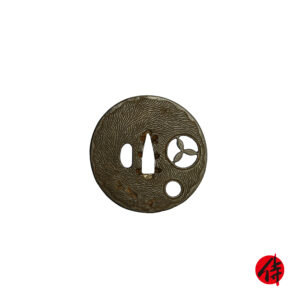
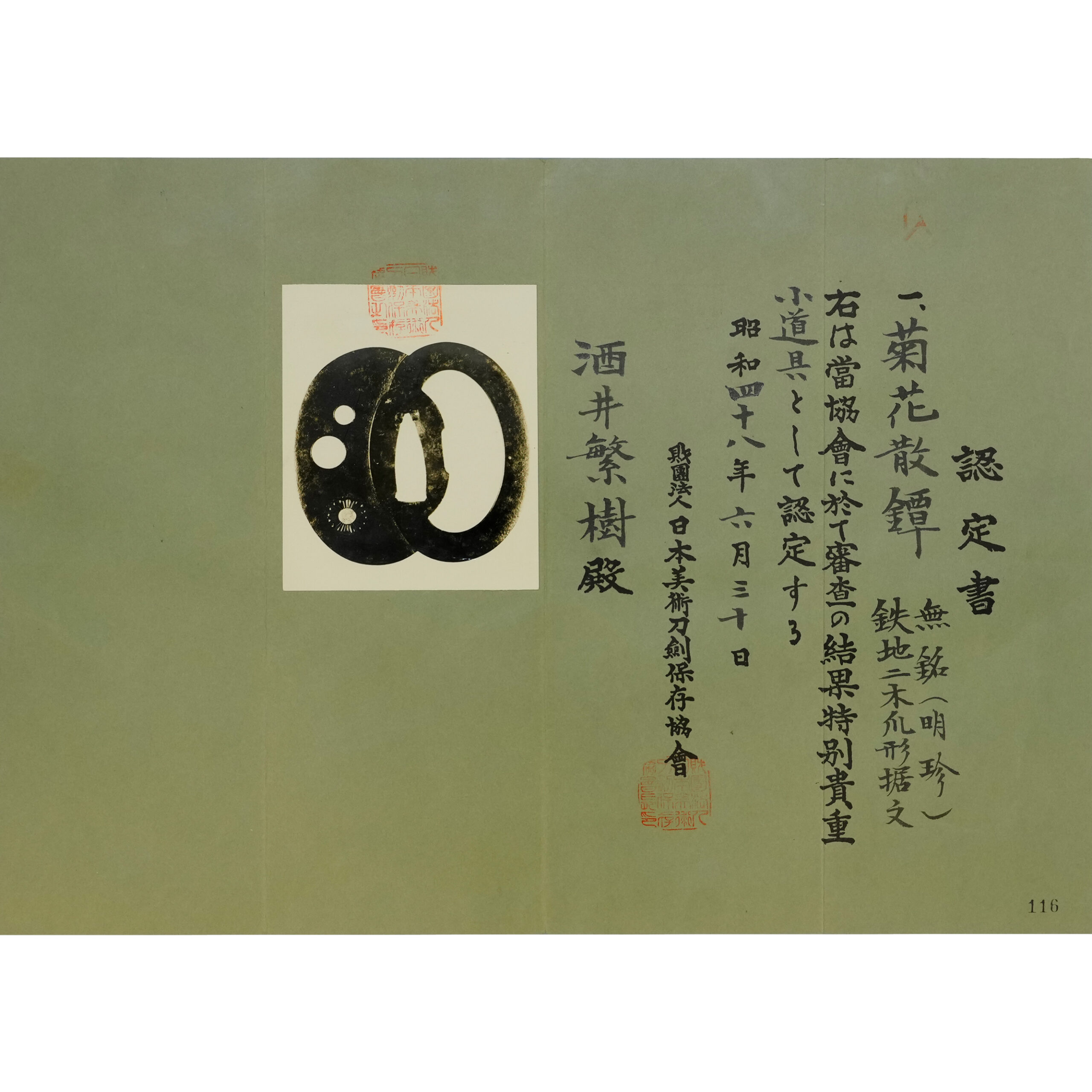
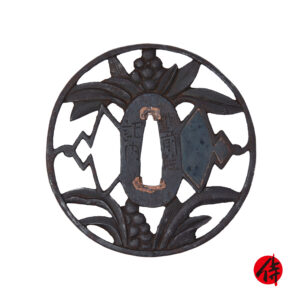
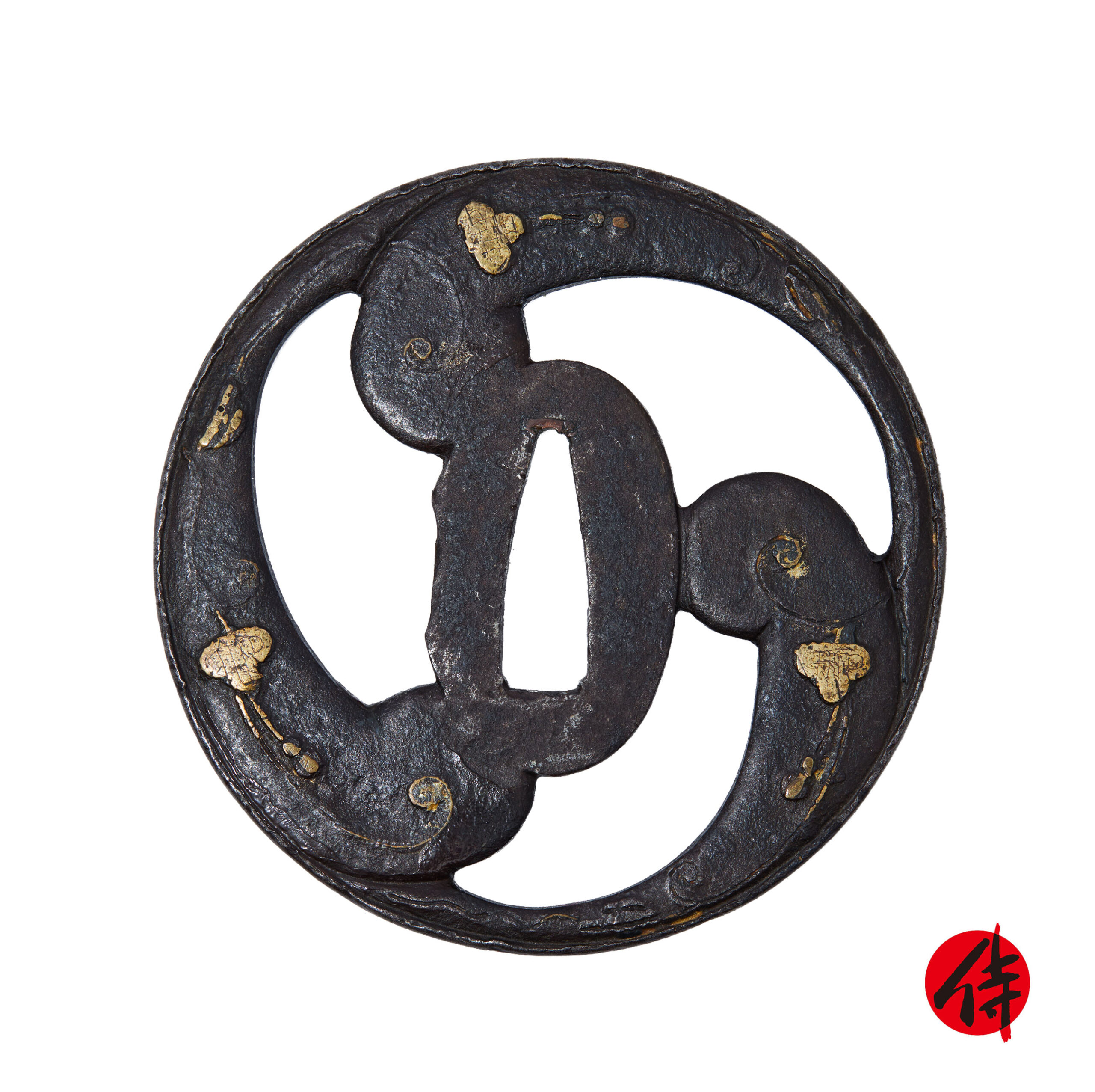
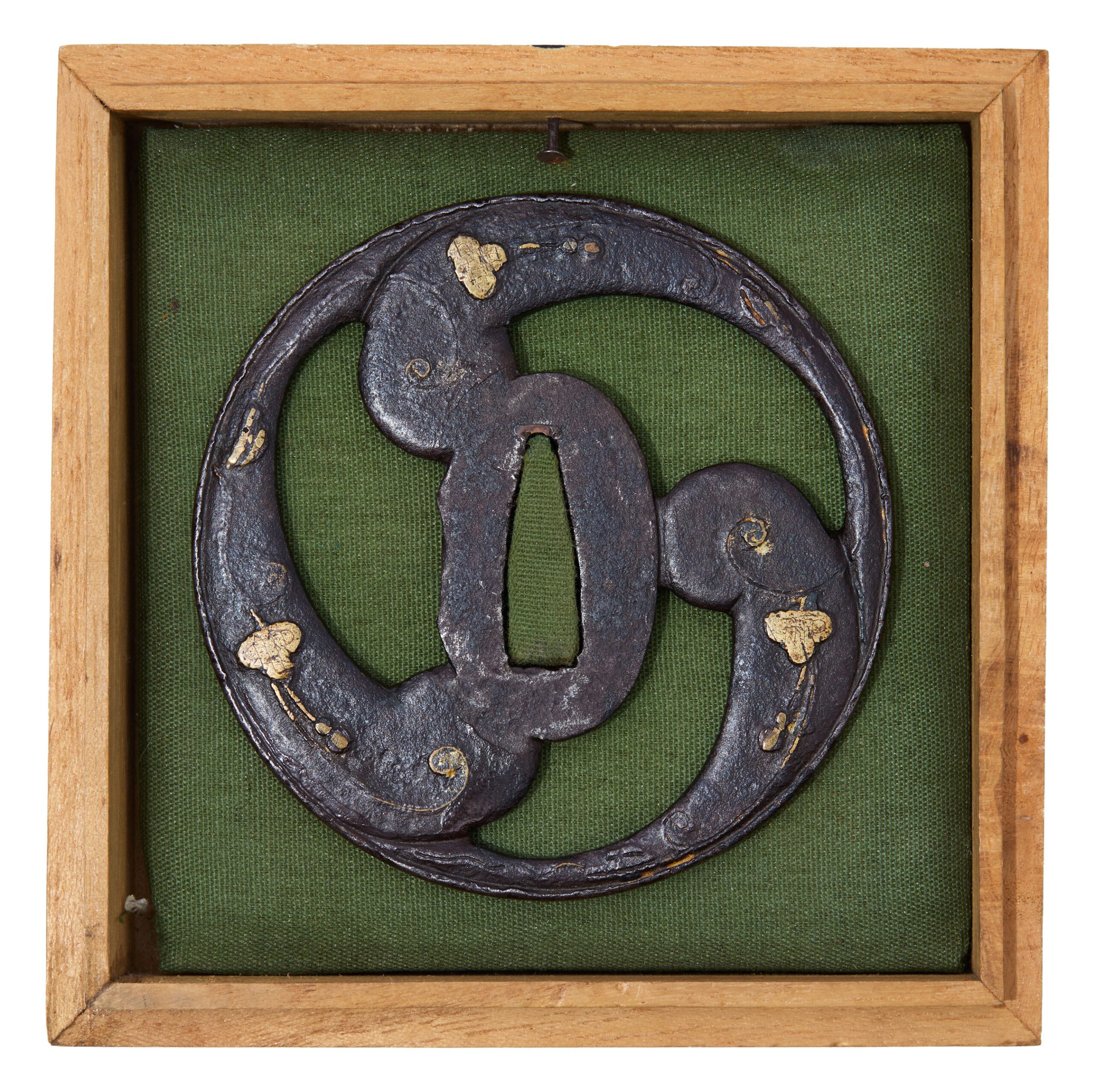
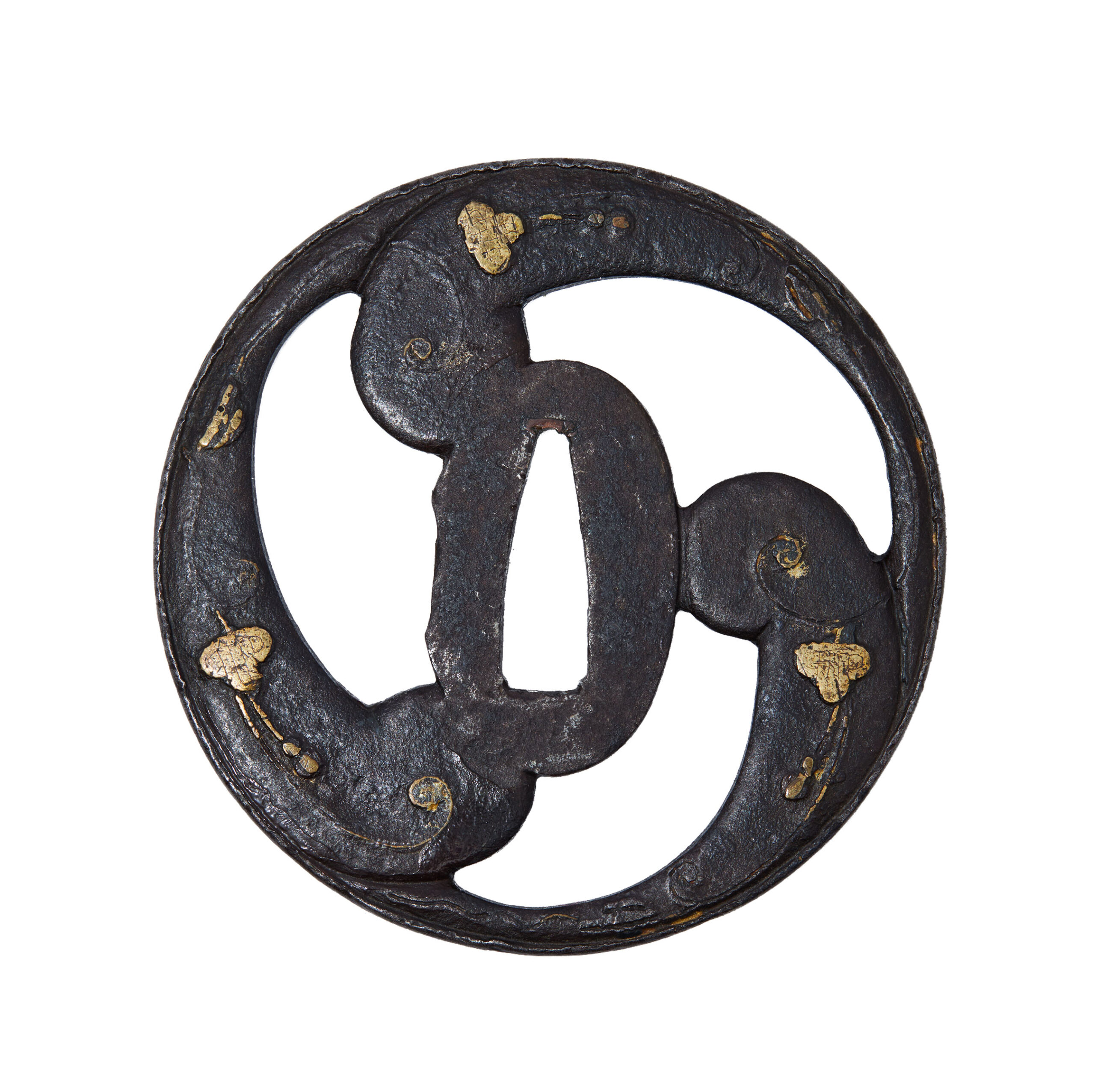
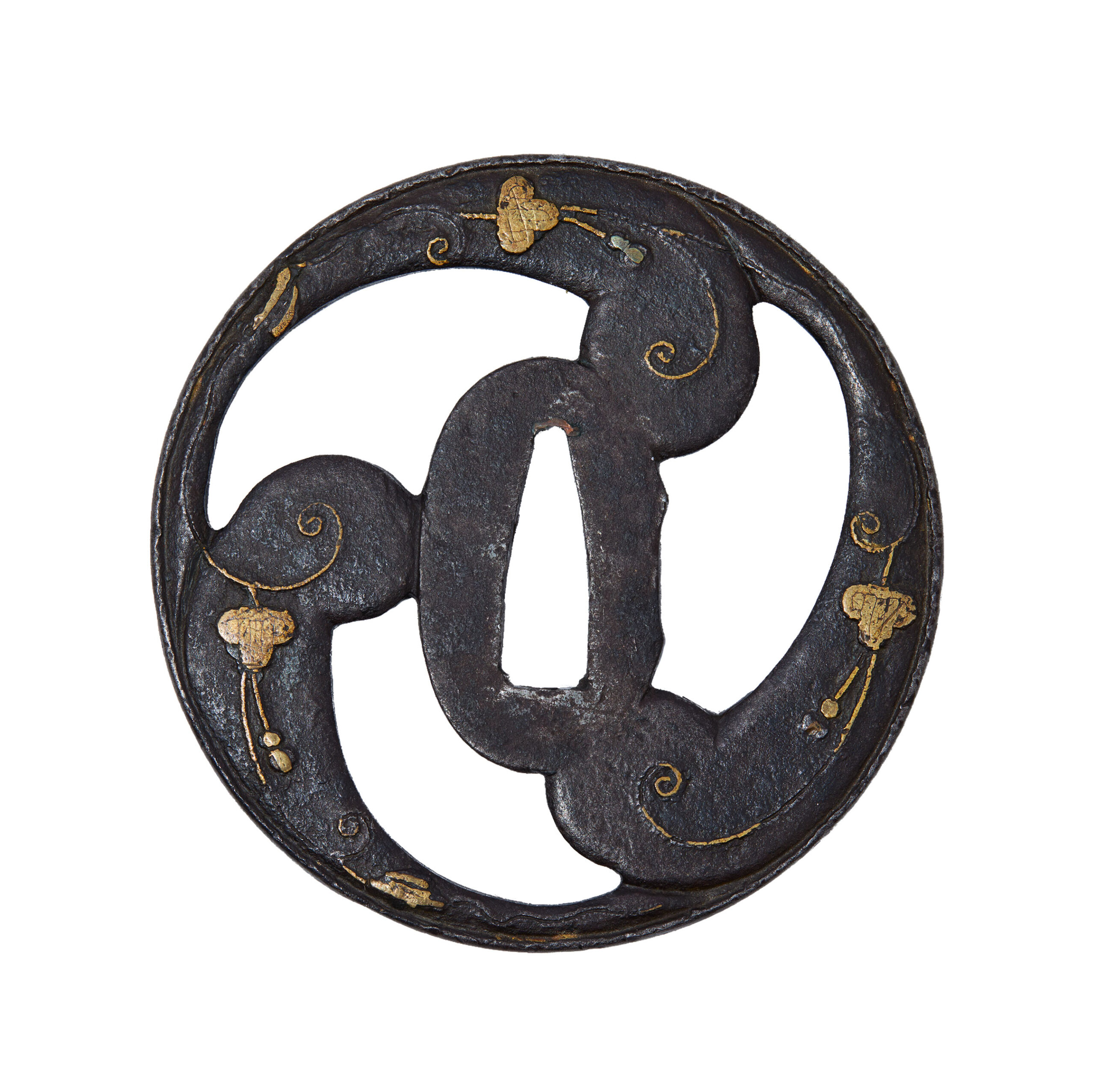
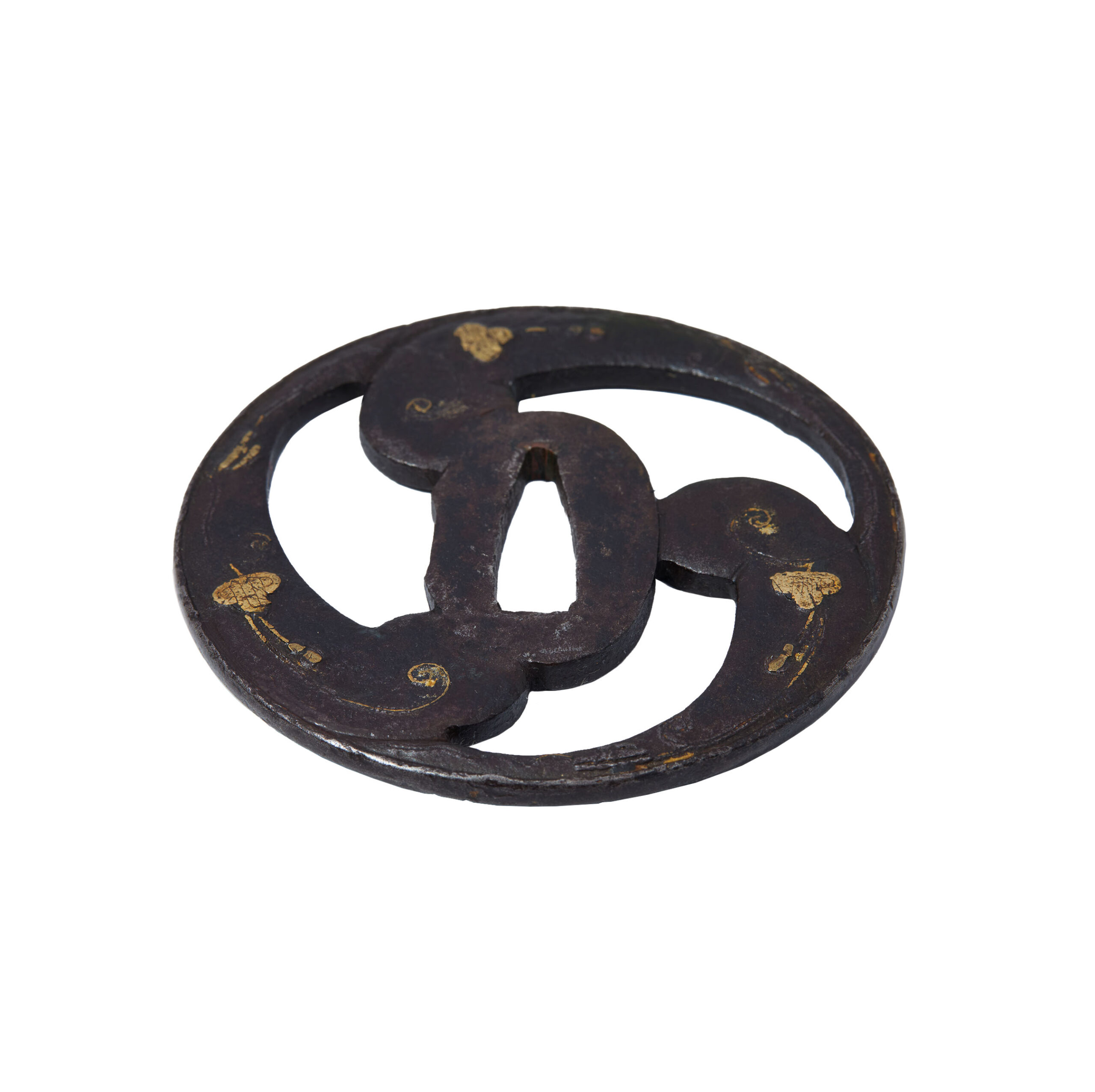
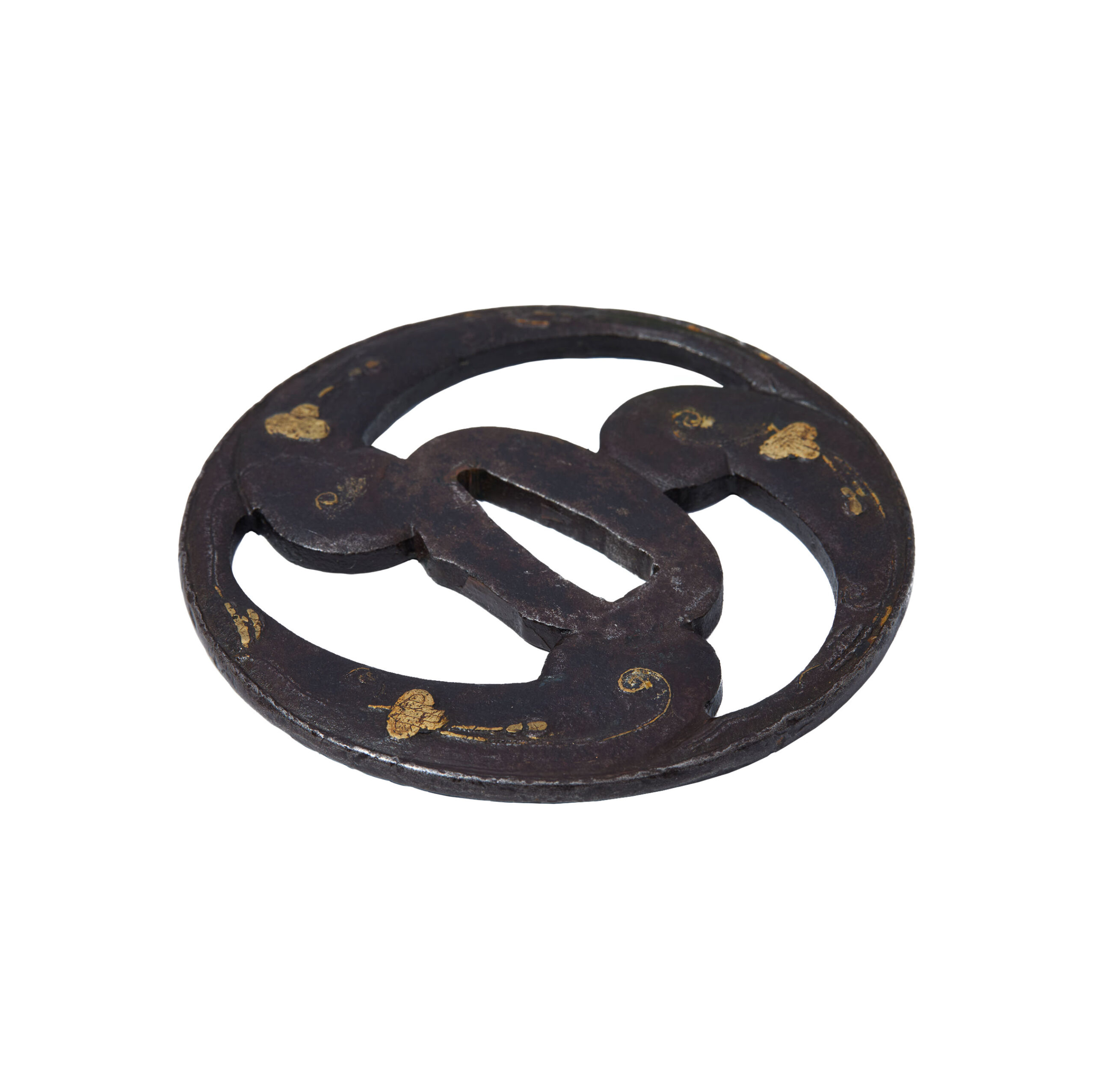
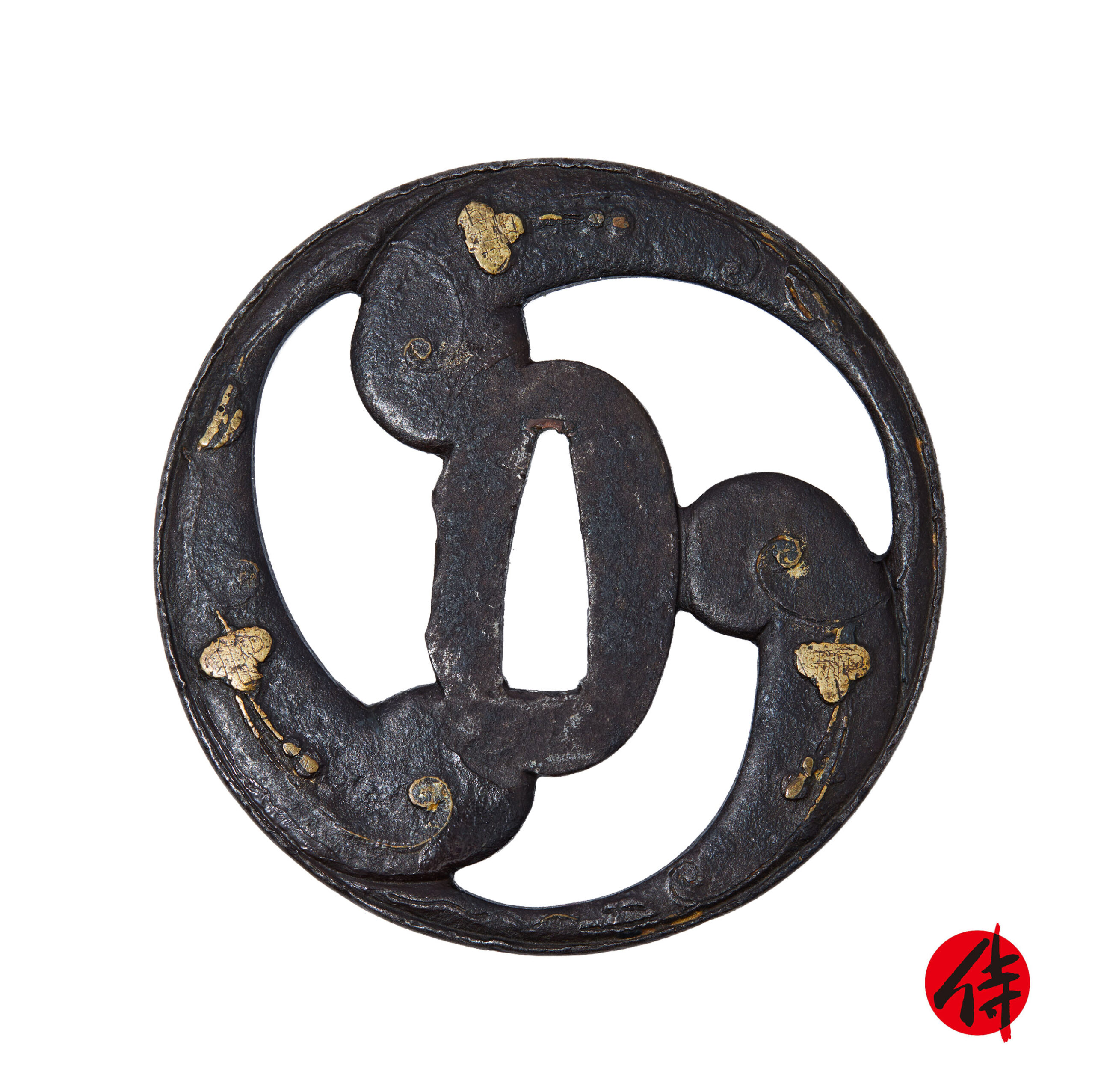
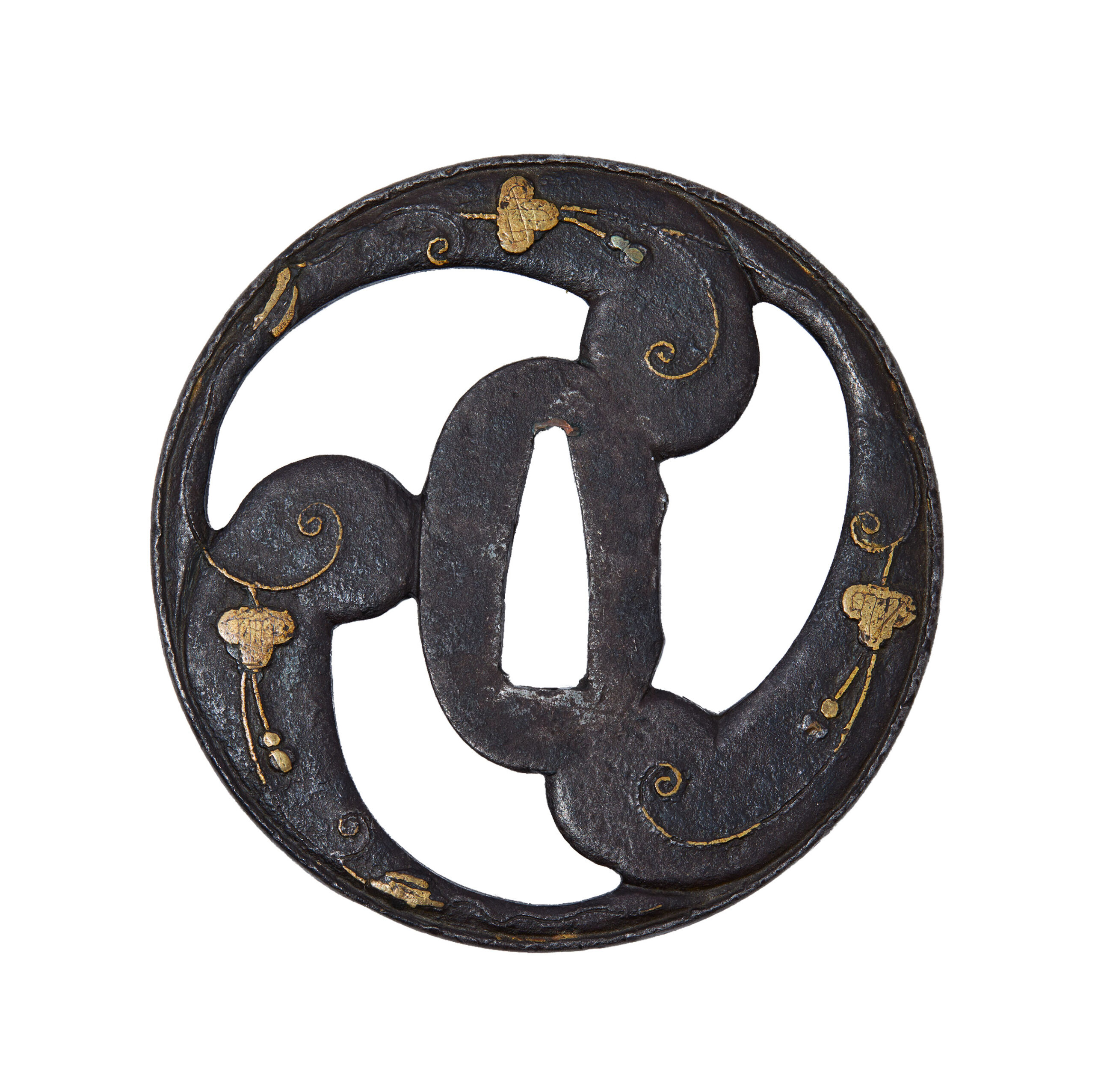
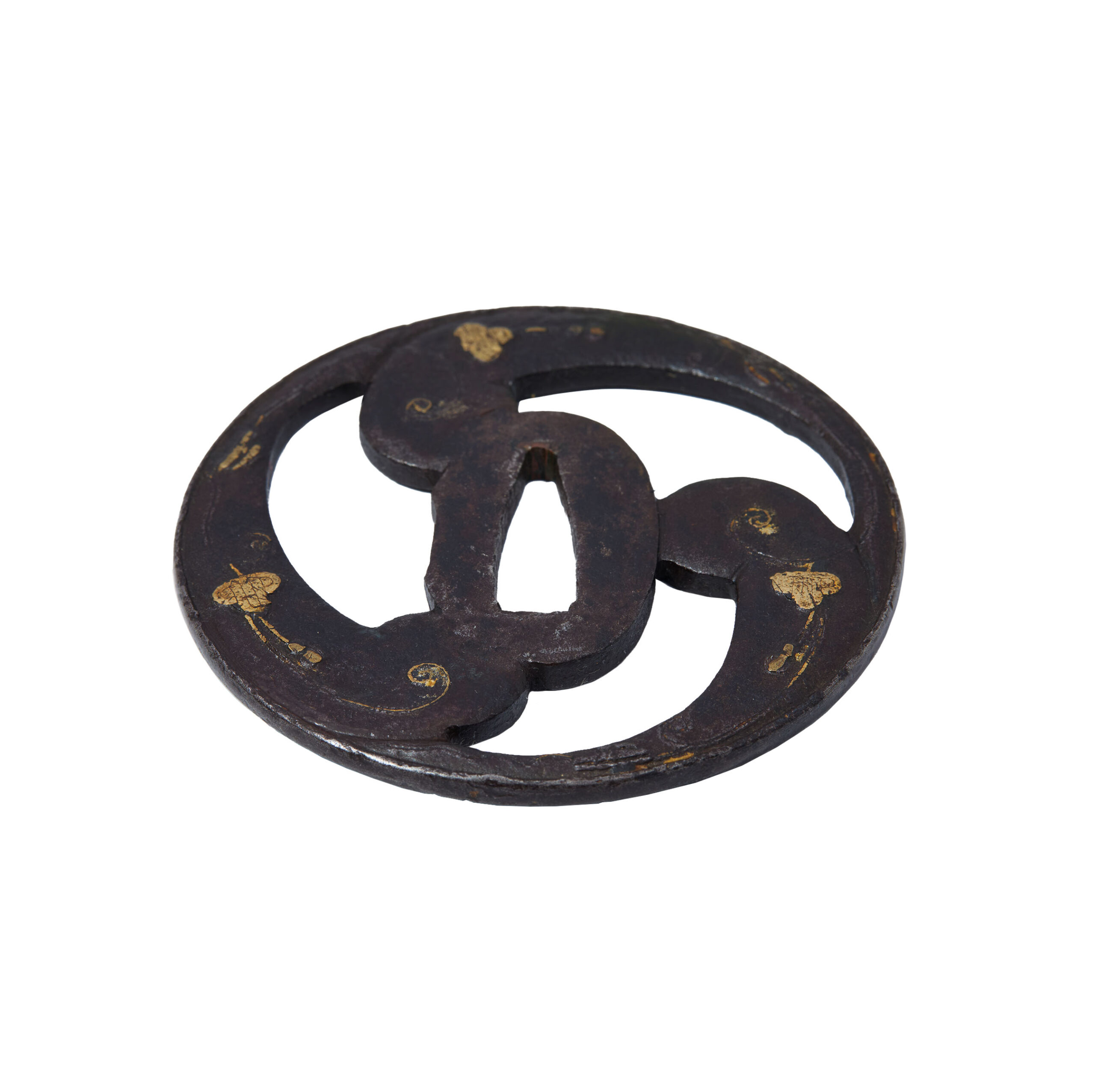
The theme of this tsuba, as well as the accompanying fuchi-kashira, is a family crest known as Mitsu-Domoe (三つ巴). The Mitsu-Domoe motif is rendered in sukashi-bori (openwork carving), a technique in which the design is cut through the metal plate itself. This method not only creates a striking visual contrast between solid and void, but also demonstrates the craftsman’s skill in achieving both structural balance and aesthetic elegance.
There are several theories regarding the origin of the Tomoe (巴) design. One theory suggests that it was inspired by the shape of magatama (勾玉), comma-shaped beads used since ancient times in Japan. Another theory associates the motif with the swirling motion of flowing water. It is also said that the Tomoe derives from the tomo (靹)—a protective leather guard worn on the inside of the left wrist by archers to prevent the bowstring from striking the arm or bracelet after releasing an arrow.
Because the Tomoe motif is closely associated with water, it was traditionally regarded as a talisman against fire. For this reason, it was frequently used on roof tiles of shrines and temples, where it was believed to ward off fire and exorcize evil spirits. A design composed of two comma-shaped elements is called Futatsu-Tomoe (二つ巴), while the pattern formed by three such elements is known as Mitsu-Domoe (三つ巴).
In addition, motifs resembling Bonji (梵字)—Sanskrit characters used in Esoteric Buddhism—are sometimes found in Japanese family crests and sword fittings. In sword-related carvings, Bonji associated with Fudō Myō-ō (不動明王, Acalanātha) or his manifestations are especially common. Fudō Myō-ō was deeply revered by samurai warriors as a guardian deity, symbolizing immovable resolve and protection in battle. According to Buddhist belief, he is considered an incarnation of Dainichi Nyorai (Mahāvairocana), the principal deity of Esoteric Buddhism. One of the most frequently seen Bonji characters in sword carvings is “Kān” (カーン), which represents Fudō Myō-ō, and related forms such as “Kanmān” (カンマーン) are also known. During the medieval and early modern periods, it was common for samurai to incorporate religious symbols into their armor, helmets, and sword fittings as expressions of faith and spiritual protection.
Complementing the openwork Mitsu-Domoe design, this piece is further adorned with Aoi-Karakusa (葵唐草) executed in gold inlay (kin-zōgan).
Aoi (葵) refers to a plant characterized by heart-shaped leaves branching from each stem. As these leaves are said to turn toward the sun, the word aoi was associated with aogu (仰ぐ, “to look up”), leading people to regard the motif as a symbol of good fortune.
Karakusa (唐草), or arabesque, is a pattern formed by intertwining vines and leaves in continuous, flowing curves. Because vines grow vigorously and extend endlessly, this motif came to symbolize prosperity, longevity, and uninterrupted lineage. In Japanese wordplay, tsuru (蔓, vine) can also be read man, which echoes the character 万 meaning “ten thousand.” Furthermore, the interconnected vines resemble an obi (帯, belt), whose alternative reading tai is associated with 代, meaning “generation.” Through such layered associations, the Karakusa motif expresses wishes for prosperity lasting for countless generations.
Together, the Aoi-Karakusa pattern—combining the auspicious symbolism of both plants—has long been cherished in Japan as an emblem of good fortune, longevity, and the enduring prosperity of one’s family or clan.
What is Tsuba?
Tsuba is the hand-guard of the Japanese sword. High-class Samurai wore his Katana sword with its beautiful sword mountings such as Tsuba. Tsuba’s front design tends to be more decorative as this part was often seen by other Samurais when he was walking on the streets.
Why is it that the sword mounting was important for Samurai?
The sword mountings of the Japanese sword have many kinds of decorations such as handguards (Tsuba), sword hilt (Menuki), pommel (Fuchi Kashira). The Japanese sword worked as a weapon and as an object to show who he was. For example, it shows their personalities and beliefs. You could say that it is like decorations for smartphones today. We recommend you zoom in on the pictures of the sword fittings. When you do so, you can see the skill of Japanese metal engraving techniques. They are mainly made of iron and copper with inlays of gold, silver, and bronze. When it comes to handguard (Tsuba), each one has a different outline and weight. These sword fittings that have lived with Japanese swords of the same age might be worth as much as the Japanese swords. They are inconspicuous parts of the Japanese sword. Nevertheless, if you are knowledgeable or particular about it, you will become a connoisseur of the Samurai.
【About us】
Samurai Museum is located in Tokyo, Japan, exhibiting antique artifacts related to the Samurai history. Samurai Museum Shop is the place for those who are interested in Japanese culture and craftsmanship. We deal with antique Samurai swords/armor, traditional crafts made in Japan and so on.

【Payment method】
We accept payment through Stripe (Credit card), PayPal, Apple Pay or ChromePay, all of which are secure payment methods. Also, you don’t need to make an account on Stripe for the checkout. If you prefer other payment method, please contact us. You may either pay in JPY, USD, AUD, CAD, EUR, CHF or GBP. The price is set in Japanese Yen. Prices in other currencies are automatically calculated based on the latest exchange rate.

【Shipping duration】
We normally ship via EMS (Express Mail Service) provided by Japan Post. It usually takes at least 5-14 days to deliver the package after you place an order. Time of delivery is estimated as accurately as possible by the carrier but does not take into account any delays beyond our control such as by inclement weather, post office holiday seasons.
We offer Free International Shipping as long as we can ship your order by EMS. If you prefer other shipping carriers, please contact us.
We will inform you of the order’s tracking number via email. Please make sure you fill out your valid email address correctly.
*If you like to make sure if EMS shipping is available to your country, please contact us.

【How to make sure the condition】
Please keep in mind that what you are going to purchase is an antique item. We uploaded high resolution photos for you to check its condition thoroughly. If you like to see more photos with different angles, please feel free to contact us. We will be happy to send them to you so that you can make informed decision.
It is essential for us to know that you are happy with your choice of Tsuba and we are prepared to use the best of our ability to serve you.
【How to appreciate Tsuba】
While Tsuba is a small component of Japanese sword mountings, we would say it is one of the most conspicuous parts. Also, unlike the blade itself, Tsuba has a low risk of handling. Furthermore, it does not require a large space for storage. Thus, Tsuba is relatively easy to collect. Here we would like to propose a few ways to enrich your Tsuba experience after purchasing your favorite Tsuba.
-Inspection
Inspect and feel the artistry of Tsuba. You will be amazed by the maker’s work quality to make it look a great work.
-Find the right place to display
Tsuba would look great when displayed in the best way. Find the best place in your house, your office, or anywhere you like, so that Tsuba would be appreciated as much as you like.
-Learn the details
Tsuba reflects quite a lot of detailed features of its maker. Sometimes you can find the maker’s signature on Tsuba. Tsuba makers tried adding elaborate artistry to Tsuba. Many techniques were invented to achieve this goal, such as openworks, engravings, and gold/silver inlays. There were many schools that trained Tsuba creators, and each of them has different characteristics. You would enjoy knowing these differences and find your beloved style.
-Arrange in modern style
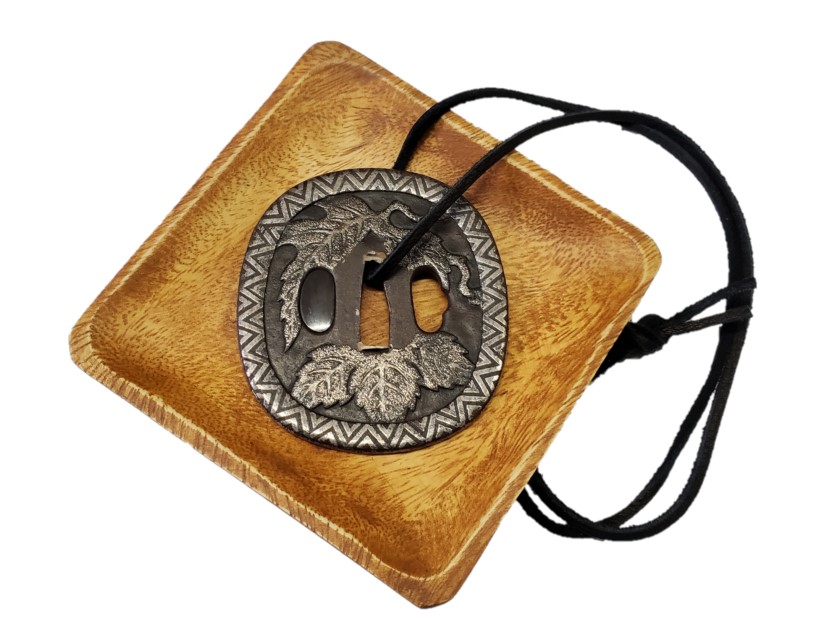
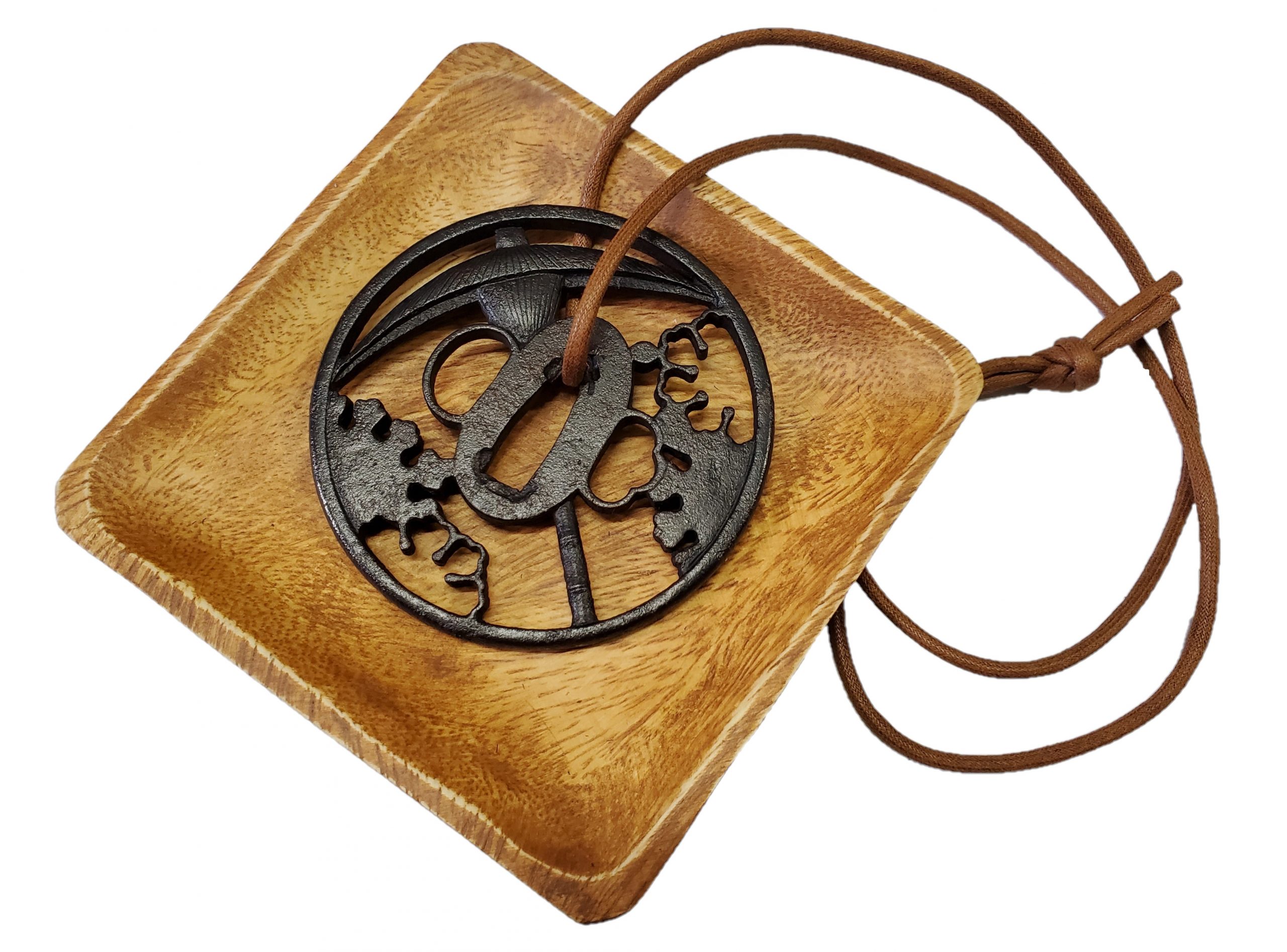
We want to propose to you the way that you could enjoy the Tsuba as jewelry. By stringing a cord into the center hole of the Tsuba, it could be worn as a necklace. This modern way would show you a new charm of Tsuba. Here are the examples of neckless.
【Give the Tsuba as a special gift】
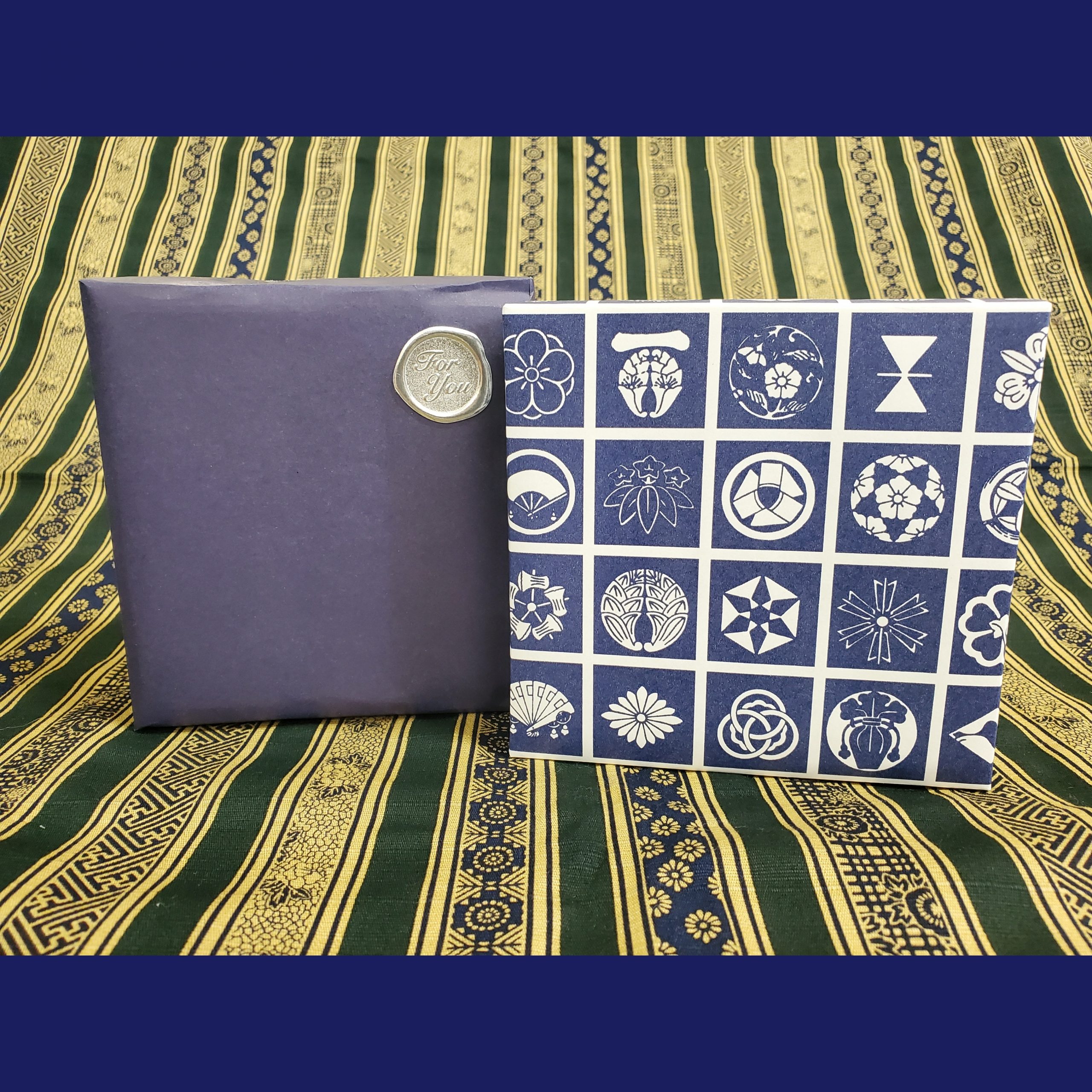
Are you looking for a special gift for a person who is interested in Japanese culture? We recommend you to give an antique Tsuba as a present for your significant other. Tsuba is an integral part of the Samurai sword, which was once a primary weapon for Samurai. Each Tsuba is a unique item and has a different design. We hope it would be a memorable gift. Now it is time for you to share the beauty of a piece of Samurai history with your family members or friends, for instance. Also, gift wrapping is available for Tsuba; it is for free. Here is an example of wrapping. For more information, please feel free to contact us. It is always our pleasure to serve you.
Would you like see some more Tsuba for sale? Please check the link below. We hope you can find your favorite Tsuba.
https://www.samuraimuseum.jp/shop/product-category/decorations/tsuba/